What counts as weight pull equipment, and why it is written down
In weight pull the dog lifts nothing. It moves a loaded vehicle a measured distance from a standing start. Under United Kennel Club rules a qualifying pull means moving the weighted vehicle 16 feet in 60 seconds or less without a foul, excusal or disqualification, and the start and finish lines must be exactly 16 feet apart on every surface.[1] The International Weight Pull Association sets the same task in its own words: each dog shall be required to pull a loaded sled or cart a measured sixteen feet within 60 seconds.[3, 4]
Sixteen feet is the easy part to describe. The hard part is that the same dog pulling the same poundage over those sixteen feet is doing a completely different job depending on what the load is sitting on and what the dog is standing on. That is why the equipment gets a chapter of its own in the UKC rulebook and a section of its own in IWPA’s, and why this article exists: most of the sport’s fairness, and a good share of its safety, lives in the specifications rather than in the scoring.
Peterbuilt Boerboel does not train for or compete in weight pull. We read the paperwork and write about the sport from the outside. Everything below is paraphrased from the two rulebooks named in the sources, both read in full on October 26, 2026, with chapter and section numbers given so you can check any line yourself. We do not sell, recommend or review harnesses, carts or any other equipment, and you will not find a brand named on this page. If you are new to the sport, start with our beginner’s guide to dog weight pull and come back here for the hardware.
The weight pull harness: what the rules require
The harness is the one major item the host club does not supply. UKC puts it under equipment provided by the exhibitor: the owner must provide each dog with a well-fitted weight pull harness prior to competition. The rulebook then constrains it in four ways.[1]
- Reach. The rear of the harness can only extend a maximum of two feet behind the dog, measured from the base of the tail.
- A dowel at the rear. The rear of the harness must have a dowel to prevent the sides of the harness from pinching or rubbing the hips and legs of the dog when pulling. Wooden dowels are preferred.
- Condition.It is the handler’s responsibility to ensure the harness is in good condition and free of any fraying or weakening that may cause it to break during the pull.
- Banned hardware. Plastic clasps, Velcro, elastic, springs and shocks are prohibited from being used on a weight pull harness.
IWPA reaches the same place by a shorter route. Under its eligibility rules, for the safety and protection of the dog, all dogs shall be fitted properly with a freight or weight pull type harness which extends no more than 24 inches from the base of the dog’s tail, and the contest section lets a judge measure any competing dog’s harness at any time during the class, taken from the base of the tail to the farthest extent of the harness measured approximately parallel to the ground.[3, 4] IWPA sets no dowel requirement and no list of banned fasteners.
Two smaller UKC rules shape what the harness does to a dog’s day. When a dog is called from the holding area to the on-deck area it is harnessed and stays harnessed until it is called to the chute or eliminated, although the harness may be removed between pulls as long as that does not cause delay. And the harness is the only thing the load attaches to: the single collar permitted during weigh-in, in the chute and in the on-deck area is a flat buckle, snap or martingale no more than two inches wide, or no collar at all, with every other collar type and any hanging tags prohibited in the chute and on-deck areas.[1]
Because the harness is handler-supplied, UKC also treats its failure as the handler’s problem. If any part of the harness or other equipment provided by the handler breaks, a foul is assessed. If club equipment such as the cart or a trace line breaks, the handler gets to re-pull that round one time with no foul or pass assessed.[1] IWPA is gentler and does not distinguish: if any part of the harness or other equipment breaks, the handler has 60 seconds to repeat the pull after repairs, or may choose to accept the interrupted pull as a pass.[3, 4]
Note on what this section does not do. Neither rulebook describes how a harness should be built or who should build it, and we are not going to fill that gap with an opinion. Fit is a matter for an experienced club judge who can see the dog. What the rules give you is a list of what a harness may not contain, which is a useful thing to be able to check at a glance.
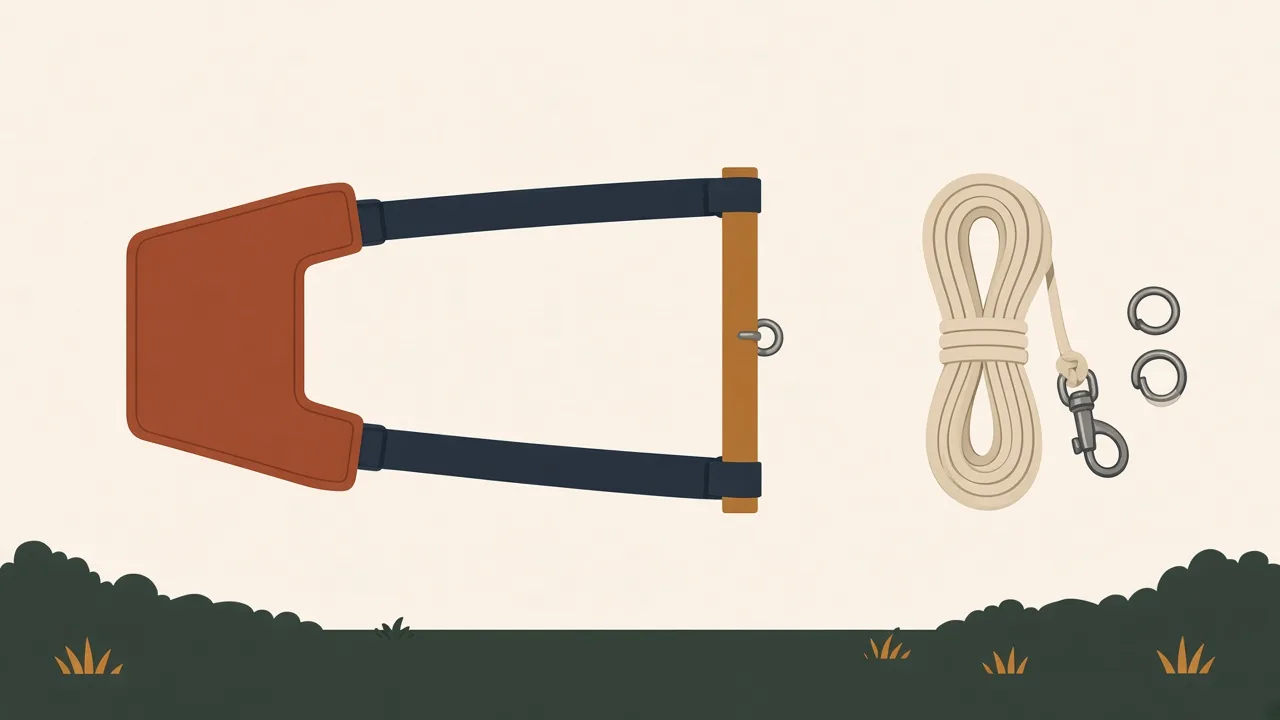
The chest piece spreads the load, the straps run back along the flanks, and the rulebook's one structural demand is the dowel across the rear so the sides cannot pinch the hips and legs. The rope trace and its enclosed metal snap belong to the club.
Original AI-assisted illustration. A conceptual drawing of the gear, not a product photograph, a brand recommendation, or a harness fitting guide.Traces: the lines between dog and load
Traces are the club’s equipment, not the handler’s. UKC requires traces made of rope or nylon to attach the weighted vehicle to the dog’s pulling harness, attached at both ends by sturdy enclosed metal rings or snaps, and then says plainly that the traces will vary per type of weighted vehicle being used.[1] Each vehicle gets its own shape and its own permitted length.
Looking down on the start, with the weighted vehicle at the bottom and the ring on the dog's harness at the top. The shape is set by the vehicle, not by the handler.
Rail cart
A single straight line from the cart to the harness, 2.5 to 4 feet long.
Snow sled
Two lines knotted together 2 to 3 feet ahead of the sled, then one tug line to the harness.
Wheeled cart
Two lines running the whole way to one ring at the harness, 5 to 6 feet long.
Original diagram. Shapes and lengths from the UKC Weight Pull Rulebook, Chapter 4, Section 1. Not to scale, and not an equipment construction plan. IWPA measures its bridles from the start line instead, so these lengths do not transfer to an IWPA pull.
The Y is the one worth reading twice. For a sled, the traces are tied together a minimum of two and a maximum of three feet in front of the sled, forming the Y, and must be long enough to allow a maximum of six feet from the point of attachment on the sled to the attachment on the dog’s harness once the knot has been tied. UKC’s definitions call the single line below that knot the tug line.[1]
How much slack is allowed is a rule, not a habit. The handler may place the dog anywhere between the wheels or runners in front of the vehicle, positioned with the harness D-ring forward of the trace line before being hooked. From there UKC allows no more than one foot of slack in the trace when releasing the dog, and when the dog is released the trace must be in contact with the pulling surface. Releasing a dog after the trace has come off the ground is a listed foul, and the rulebook defines a slingshot start as a release with more than one foot of slack running in. The trace line itself is marked on the pulling surface by setting the vehicle on the start line, extending the trace out tight and measuring back one foot.[1]
IWPA covers the same risk without a number. Its booklet asks for enough slack in the tug line to prevent the dog from inadvertently moving the sled or cart, but not so much slack as to allow a slingshot start, and requires that a defined stop in the forward motion of the dog be achieved.[3, 4] It also rules out two materials UKC does not mention: IWPA bridles must be rope or nylon, and chains or cables will not be allowed.
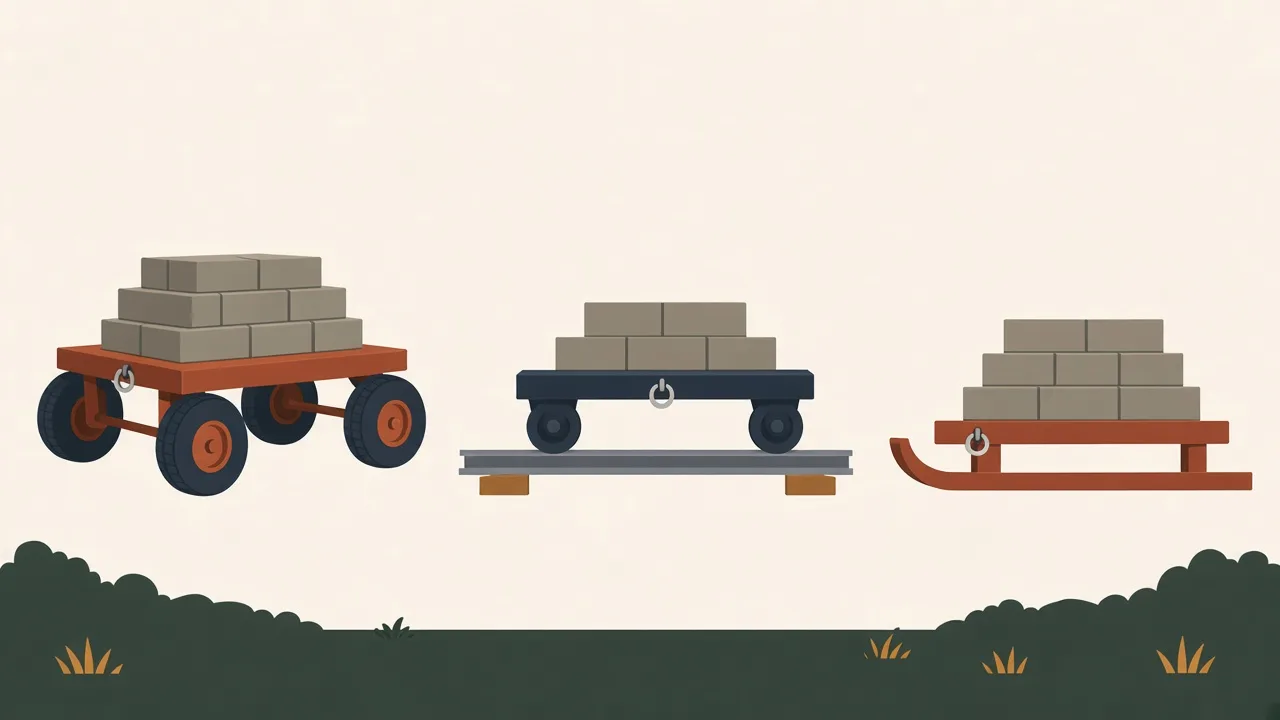
Weight pull cart, rail system and sled: the three weighted vehicles
UKC recognises three, all supplied by the host club: the rail cart, the wheeled cart and the sled. Before any of them is used, the judge is responsible for examining the weighted vehicle and all trace and cart handler lines to ensure the function and safety of all pull equipment.[1]
The wheeled cart
Used for weight pulls on natural and artificial surfaces. It must be capable of safely carrying a load in excess of 5,000 pounds, with a solid weight-bearing surface of wood or metal that cannot be hollow, two axles, and the ability to stand freely without tipping over. The front carries two solid rings for the trace rope, which is what gives the wheeled cart its long V. It runs on four fixed tires with a minimum diameter of eight inches and a maximum of eighteen, measured directly across the centre from the outer edges, and all four are required to have the same air pressure before the pull starts. A spare tire or an adequate repair kit must be available at the pull site.[1]
The rail cart and its track
A rail cart rides on a track of angle iron like a small railway and must be capable of safely carrying a load in excess of 6,000 pounds. A typical cart is steel, measuring 4 feet 8 inches square from the outside edges, though any size is acceptable provided construction, design and materials are strong and safe enough. It carries at least four heavy-duty wheels, one at each corner, or six with the extra pair mounted at the middle of each side. The wheels may all be V-groove, or two or three V-groove with two or three flat wheels on opposite sides; the rulebook explains that the V-groove holds the cart on course as it rides on top of the angle iron rails. Rail cart wheels are small: three inches for the small cart used by the lightest classes, and four to six inches for the larger cart, with four inches preferred.[1]
The track is specified too. The rails must be strong enough to carry the maximum weight of the cart, and there must be welded stops on both ends so the cart cannot roll off. Legs let the track be levelled on an artificial surface. The pulling surface lies between the rails and must be covered with carpet so the dog can gain traction: the recommended width of that lane is four feet and its minimum length is thirty feet.[1]
One widely repeated claim about rails is worth correcting, because we started with it in draft and the rulebook says the opposite. A dog that steps off the carpeted lane and pulls on the ground beside the track is notpenalised. UKC’s scoring chapter states that no penalty shall be assessed for a dog that pulls on the ground instead of on the rail track.[1]
The sled
The weighted vehicle for all weight pulls on snow. It must be capable of safely carrying a load in excess of 3,000 pounds, with a minimum width of 30 inches and a maximum of 48. Each sled is required to have two runners providing a minimum of seven feet of contact surface. The runners should be made of steel or ptex, have a minimum width of two inches and a maximum of four, and their front ends must curve upward.[1]
All three vehicles come with the same concession for small dogs: a smaller and lighter rail cart, wheeled cart or sled may be used for the 10 to 40 pound weight classes provided the smaller version still meets the requirements above.[1]
The pulling surface, and the rule that ties it to the vehicle
One sentence in UKC’s general rules does more work than any other equipment clause: the surface on which the dog gains traction must be the same as the surface under the wheels of the cart or the runners of the sled being pulled.[1] IWPA requires the same thing in both halves of its physical area section, for snow and for wheeled pulls alike.[3, 4] It is the reason the rail system carpets the lane between its rails rather than leaving bare ground, and the reason no federation lets a dog dig into dirt while the load rolls on carpet.
UKC lists three surfaces, and every one of them must carry clearly marked start and finish lines exactly 16 feet apart.[1]
- Natural. Hard packed dirt, fine packed stones or grass.
- Artificial. Asphalt, concrete or wood, and it must be covered with carpet.
- Snow. Hard packed natural snow, or packed ice shavings such as those from an ice skating rink. A snow pull also requires a break line exactly two feet behind the start line, so the sled can be moved from break line to start line and its runners are not frozen to the ground when the dog is asked to go.
Snow
A sled meets the most resistance. The totals are lower.
Wheels
The cart rolls, but grass, dirt and artificial surfaces differ.
Rails
Low rolling resistance allows much higher totals.
IWPA’s acceptable wheeled surfaces are grass, hard packed dirt, gravel or carpet, which admits gravel where UKC specifies fine packed stones, and it uses the same two-foot break line on snow.[3, 4] Its older Overview of a Pull page describes that as a setup line one foot behind the start instead. Where the two disagree, the rule booklet is the rule, and we flag it rather than quietly picking the tidier line.[5]
Both bodies also protect the surface from mid-class improvement. UKC allows the pull area to be checked and groomed only between weight classes, with the host club deciding how often and announcing it at the handlers meeting. IWPA puts course maintenance in the Sled Marshal’s hands and says the track is only to be groomed between classes.[1, 3] The one thing a handler may do to a dog’s feet is narrow: pads must be clean and free of any artificial aid designed to improve traction, and when pulling on carpet pure water may be applied to the pads in the on-deck area.[1]
The chute: equipment you can stand in
UKC divides the pull area into three parts, the holding area, the on-deck area and the chute, and requires the judge to walk the pull area before the pull starts and verify that it has been properly set up, is free of hazards and is as safe as possible.[1]
The chute is a minimum of 10 feet wide and a maximum of 20, and a minimum of 35 feet long with no maximum, because the sixteen measured feet need room behind the start line for the dog and the loaded vehicle and room beyond the finish line for the dog and handler. It must be placed where the ground is as level as possible and the surface is most likely to stay consistent through the pull. When a level chute is not possible, dogs pull from the low end toward the high end, and whatever the slope, the starting position must not allow the cart to roll freely. The end the dog is pulling toward stays open and clear of all dogs, crates and spectators, and no dogs at all are allowed in front of the start line outside the chute.[1]
Two barriers frame it. A chute barrier at least three feet high, running the entire length of the chute, is required for all pulls, and may be made of any material that will discourage dogs from leaving the chute during the pull. A crowd barrier of at least three feet, also running the full length and placed at least three feet back from the chute barrier, is recommended rather than required, and may be anything that prevents spectators interfering with the dogs.[1]
IWPA sets the same chute dimensions, 10 to 20 feet wide and not less than 35 feet long, opening on the end toward which the pull is made, and the same preference for pulling toward the higher end on any perceptible slope. Its barrier rule is more specific about materials: the chute barrier must be at least three feet high and not less than 35 feet long, sited at the very edge of the pulling pad, and plywood, wood planks, hog panels and other materials with a bouncing-off or glancing ability are named as appropriate, while snow fence is explicitly not an acceptable barrier. A sled or cart that becomes stuck or lodged on a barrier counts as a tangle rather than a failure. Unlike UKC, IWPA requires a crowd barrier separating spectators by a minimum of three feet from the chute, and says a rope barrier is adequate for the purpose.[3, 4]
What is not allowed near the equipment
The banned list is short, and almost all of it is about removing ways to make a dog pull harder than it chose to.[1]
- Traction aids on the pads. Prohibited outright. Pure water on carpet, applied in the on-deck area, is the only exception.
- Noisemakers and whips. Neither may be used to encourage dogs to pull, and both are prohibited from the chute and the on-deck area.
- Food and lures. Handlers may not bait a dog in the on-deck area or the chute, and may not carry any bait there. A judge who believes a handler is baiting, or simply has bait on their person, must excuse them.
- Harness hardware. Plastic clasps, Velcro, elastic, springs and shocks, anywhere on the harness.
- Collars and tags. Anything other than a flat buckle, snap or martingale up to two inches wide, plus any hanging tags, is out of the chute and the on-deck area.
- Visible leashes. A leash may stay on until the harness is hooked to the traces, then must be removed and pocketed completely out of sight until the pull is complete. Pulling with a leash on the dog, or having one visible on your person, is a listed foul.
- Hands. Once the dog is released the handler may not touch the dog or any equipment again until the judge indicates the pull is complete.
IWPA’s list reads as a stricter version of the same instinct, and it names several items UKC leaves to the general traction rule: whips, noisemakers, muzzles, pinch collars, nail caps, paw grips, booties or related aids shall not be permitted at any time during an IWPA event. Throwing items while the dog is in the chute counts as baiting, handlers may not have food or bait on their person in the chute area on pain of disqualification, and a dog may be rewarded only once it has left the chute area and returned to its crate, vehicle or holding area. IWPA also forbids test rolling the cart before a pull.[3, 4]
If the welfare framework behind those rules is what brought you here, we went through it in detail, alongside what the veterinary literature has and has not measured, in is dog weight pull safe?
Why weights do not compare across vehicles
Everything above comes together here. UKC does not set one qualifying weight and one ceiling; it sets a different pair for every combination of vehicle and surface, expressed as a multiple of the dog’s body weight on the day of the event. Fall below the minimum and the pull does not qualify. Reach the maximum and the dog is automatically withdrawn from the pull, which is a ceiling on the load rather than a target to fail against.[1]
Scroll the table sideways to see every column.
| Vehicle and surface | Qualifying minimum | Division A maximum | Division B maximum |
|---|---|---|---|
| Wheels on artificial surfaces | 8x | 25x | 35x |
| Wheels on natural surfaces | 8x | 20x | 28x |
| Rails | 10x | 45x | 65x |
| Snow | 3x | 15x | 25x |
All figures are multiples of the dog’s body weight on the day of the event, from Chapter 6, Section 2 of the UKC Weight Pull Rulebook, read on October 26, 2026. Division A is open to any dog that has not achieved the UKC Weight Pull Champion Excellent title; Division B is open to all dogs, and a dog that has achieved that title or higher is required to pull in it.[1] These are not rankings, and the table is page text rather than artwork so that every number stays checkable.
Read down the table and the point lands: a Division B dog on rails may be taken to 65 times its body weight before the rules stop it, while the same dog on snow is withdrawn at 25. The rulebook never explains why, and we are not going to invent a physics lesson for it. What we can quote is IWPA’s own explanatory page, which tells newcomers that on wheels on a smooth surface the dogs tend to pull three to five times as much weight as on snow.[5] That is a federation’s own characterisation of the gap, on an explainer rather than in a rule booklet, and it is enough to make the practical point.
The practical point being: a rail number and a snow number measure different jobs, and stacking them in one list produces a ranking of surfaces rather than of dogs. That is why our cross-federation records ledger never ranks raw weights across surfaces or federations, and it is the first thing to check on any published sheet. If you want to see the columns in practice, our guide to reading an IWPA results sheet walks one line by line.
Where IWPA equipment rules differ from UKC
The temptation with two rulebooks is to read one and assume the other matches. On equipment they do not, and the largest difference is the simplest to state: the IWPA Rule Booklet recognises two weighted vehicles, not three. A sled is the vehicle on snow, a wheeled cart is the vehicle if the pull is held on any surface other than snow, and we found no rail cart, no rail track and no rail division anywhere in the booklet. IWPA also keeps wheeled events separate from snow events when it counts points for the season.[3, 4] A UKC rail result therefore has no IWPA equivalent to be compared against.
The rest of the differences are smaller but they are real, and most of them would quietly corrupt a comparison if you assumed them away.
Scroll the table sideways to compare both rulebooks.
| Requirement | UKC | IWPA |
|---|---|---|
| Weighted vehicles recognised | Three: rail cart, wheeled cart and sled (Ch. 4 Sec. 1). | Two: a sled on snow, and a wheeled cart on any surface other than snow (Sec. 2A, 2B). The booklet contains no rail cart and no rail track. |
| Cart load rating | Must safely carry a load in excess of 5,000 lb; rail cart in excess of 6,000 lb. | Must be capable of safely carrying a load that can exceed 4,000 lb. |
| Sled load rating | Must safely carry a load in excess of 3,000 lb. | Must be capable of safely carrying a load of 4,000 lb. |
| Tires | Four fixed tires, 8 to 18 inches in diameter, all at the same air pressure before the start. A spare or repair kit must be available. | Four pneumatic tires, 8 to 18 inches in height, all at the same pressure before the event and at least at the maximum recommended pressure. A spare or repair kit should be available. |
| How the trace is measured | By shape and by its own length: I-shape 2.5 to 4 ft, Y knotted 2 to 3 ft ahead of the sled with no more than 6 ft to the harness after the knot, long V of 5 to 6 ft. | From the start line. The attachment to the harness must be 5 to 6 ft from the start line for both sled and cart. Same Y and long V shapes; chains and cables are prohibited. |
| Harness reach behind the dog | No more than two feet behind the dog from the base of the tail, with a dowel across the rear. | No more than 24 inches from the base of the tail, measurable by a judge at any time during the class. No dowel requirement. |
| Slack at release | No more than one foot of slack, and the trace must be touching the pulling surface. | Enough slack that the dog cannot inadvertently move the vehicle, but not so much as to allow a slingshot start. A defined stop in the dog's forward motion must be achieved. |
| Equipment failure | Handler equipment breaking is a foul. Club equipment breaking earns one re-pull of the round with no foul or pass. | The handler has 60 seconds to repeat the pull after repairs, or may accept the interrupted pull as a pass. |
| Grip aids on the feet | Pads must be clean and free of any artificial traction aid. Pure water may be applied in the on-deck area when pulling on carpet. | Nail caps, paw grips and booties are prohibited at any time during an IWPA event, along with whips, noisemakers, muzzles and pinch collars. |
Paraphrased from the UKC Weight Pull Rulebook effective September 1, 2016 and revised October 30, 2019, and the IWPA Rule Booklet revised August 2026, both read in full on October 26, 2026.[1, 3, 4]
Two further IWPA details have no UKC counterpart at all. The first is the Sled Marshal, an official made responsible for the safe and proper stacking of weight on the sled or cart, its positioning, hooking the dogs up, breaking the sled when pulling on snow and maintaining the pulling course, with the standing instruction that sled and cart officials may not block the dog. The second is what the booklet does not contain: we found no ceiling expressed as a multiple of body weight anywhere in it. IWPA caps maximum startingweights by class, from 150 lb in the 10 lb class up to 900 lb in the heaviest, and leaves the Chief Judge free to set those lower if pulling conditions are poor, but we located nothing equivalent to UKC’s automatic withdrawal at a fixed multiple.[3, 4] We report that as what we did not find rather than as a rule that does not exist.
IWPA’s small-class concession has its own wrinkle too. A smaller and lighter sled or cart may be substituted for the 10 through 40 pound classes as approved by the Chief Judge, provided a substitute sled still has two runners and a substitute cart still has pneumatic tires, and when the light vehicle’s loaded weight equals that of the full-size one, the competition may continue on the larger vehicle.[3, 4]
What owners of heavy breeds usually want to know
The Boerboel is a heavy mastiff-type breed, so the equipment questions that reach us are usually about size: whether a broad-chested dog needs different gear, and whether the big numbers mean anything. On the first, the rules are indifferent to breed. The same two-foot reach, the same dowel, the same banned fasteners and the same trace shapes apply to a 180 pound dog and a 20 pound one, and the only size-dependent equipment rule in either booklet runs the other way, allowing lighter vehicles for the smallest classes.[1, 3]
On the second, the multiplier table is the answer. Both bodies run body-weight classes and record load per pound of dog, so a heavy dog’s larger absolute figure is not by itself evidence of a larger effort, and the figure only means anything next to the vehicle and surface it came from. Our Boerboel weight pull guide covers the breed’s documented side of the sport with those qualifications attached.
We will not go further than the paperwork here. We have no veterinary source on how harness fit should differ for a broad-chested or slow-maturing breed, so we make no claim about one, and fitting a specific dog is a conversation for an experienced club judge who can see it stand. What this page can give you is the checkable part: the rulebooks, the numbers in them, and where they disagree.
Weight pull equipment: FAQ
What kind of harness is used for dog weight pull?
A purpose-built weight pull harness, provided by the owner rather than the club. Under UKC rules it must be well fitted, may extend no more than two feet behind the dog measured from the base of the tail, and must carry a dowel across the rear so the sides cannot pinch or rub the hips and legs; wooden dowels are preferred. Plastic clasps, Velcro, elastic, springs and shocks are prohibited anywhere on it, and the handler is responsible for keeping it free of fraying or weakening. IWPA words it differently, requiring a freight or weight pull type harness extending no more than 24 inches from the base of the tail, which a judge may measure at any time during the class.
Can a dog weight pull in a regular walking harness?
Not at a sanctioned pull. UKC requires a well-fitted weight pull harness with a dowel across the rear, and IWPA requires a freight or weight pull type harness within its 24-inch limit. A walking harness meets neither requirement, and the load never attaches to a collar: the only collar allowed in the UKC chute is a flat buckle, snap or martingale no more than two inches wide, or no collar at all.
What is the difference between a weight pull cart, a rail system and a sled?
They are three different weighted vehicles in the UKC rulebook, each with its own specification. A wheeled cart runs on four fixed tires of 8 to 18 inches over natural or artificial surfaces and must safely carry over 5,000 lb. A rail cart runs on angle-iron rails like a small railway, must safely carry over 6,000 lb, and sits above a carpeted lane between the rails that is recommended to be 4 feet wide and at least 30 feet long. A sled is for snow, must safely carry over 3,000 lb, and rides on two runners of steel or ptex giving at least seven feet of contact with their front ends curved upward. Because each vehicle resists differently, each carries its own qualifying minimum and its own ceiling.
How long are weight pull traces?
Under UKC rules it depends on the vehicle. Rail traces are I-shaped and 2.5 to 4 feet long. Sled traces are tied together 2 to 3 feet in front of the sled to form a Y, with no more than 6 feet from the sled attachment to the harness once the knot is tied. Wheeled cart traces form a long V of 5 to 6 feet, and the ring or snap at the harness end must be free to move from side to side. All of them are rope or nylon, attached by sturdy enclosed metal rings or snaps. IWPA measures from the start line instead, requiring the attachment at the harness to be 5 to 6 feet from it, and prohibits chains and cables.
How far does a dog pull in weight pull?
Sixteen feet, within 60 seconds. That is the qualifying pull in the UKC rulebook and the requirement in IWPA's Section 5, and UKC requires the start and finish lines to be exactly 16 feet apart on every surface. The chute itself is longer, at least 35 feet, because the dog and the loaded vehicle need room behind the start line and beyond the finish line.
Why are rail pulls so much heavier than snow pulls?
Because the vehicles meet different resistance, and the rules price that difference in. UKC's qualifying minimum is ten times body weight on rails, eight on wheels and three on snow, and its automatic-withdrawal ceiling in Division B is 65 times body weight on rails against 25 on snow. The rulebook does not explain the gap, but IWPA's own explanatory page says that on wheels on a smooth surface dogs tend to pull three to five times as much weight as on snow. The practical consequence is that a rail figure and a snow figure are not the same measurement and should never be ranked against each other.
Does IWPA use a rail system?
Not in its rule booklet. The IWPA Rule Booklet revised August 2026 specifies two weighted vehicles, a sled for snow and a wheeled cart for any surface other than snow, and keeps wheeled and snow results separate for points. We found no rail cart or rail track anywhere in it. Rails are a UKC vehicle, so a UKC rail result cannot be read against an IWPA sheet.
Sources
Every specification, dimension and multiple above was read from these documents on October 26, 2026. Where two sources from the same federation disagree, the article says so rather than choosing the more convenient one. Where we could not find a rule, it says that too.
- [1] Official UKC Weight Pull Rulebook, effective September 1, 2016, revised October 30, 2019 (introduction; Chapter 1, general rules, pull area and pulling surface; Chapter 2, exhibitors and spectators; Chapter 3, titles and classes; Chapter 4, weight pull equipment requirements and specifications; Chapter 5, procedures; Chapter 6, scoring; Definitions). United Kennel Club. https://www.ukcdogs.com/docs/rulebooks/weight-pull-rulebook.pdf
- [2] Weight Pull Forms and Rules. Its “Download the UKC Weight Pull Rulebook” link still points to the 2016/2019 edition above, which is therefore the current published edition. United Kennel Club. https://www.ukcdogs.com/weight-pull-forms-rules
- [3] IWPA Rule Booklet, web edition, revised August 2026 (Section 1, physical area; Section 2, equipment; Section 3, officials; Section 4, contestants; Section 5, the contest; Section 6, points). International Weight Pull Association. http://www.iwpa.net/Rules.html
- [4] IWPA Rule Booklet 26-27, revised 07/26, the downloadable PDF edition linked from the rules page. Its numbered items match the web rule booklet above. International Weight Pull Association. http://www.iwpa.net/files/Rule%20Booklet%2026-27%20(Revised%2007_26).pdf
- [5] Overview of a Pull, an explanatory page rather than a rule booklet. Cited here only where the article quotes it, including the two points where it disagrees with the current rule booklet. International Weight Pull Association. http://www.iwpa.net/Pull-Overview.html