
Why the sheet beats the screenshot
When dog weight pull reaches a general audience, it usually arrives as a single number with no surface, no class and no source. Organized federations publish something better: a results sheet with the class, the load, the clock and the dog’s body weight all in one row.
The International Weight Pull Association was organized in November 1984 and sanctions roughly one hundred pulls a season across the contiguous United States and Canada.[5] Its 2026 International Championships results are public, which makes them a useful teaching sheet. This article walks the columns of two of them.[1, 2]
Peterbuilt Boerboel does not train for or compete in weight pull. We read federation sheets the way a spectator reads a scoreboard: to understand the sport, not to sell a training plan. If you are new to the sport itself, start with what dog weight pull actually is and come back to the numbers.
Where these results come from
On Sunday 10 May 2026, the IWPA International Championships ran indoors at Bon Aqua, Tennessee (10950 Missionary Ridge Rd) in Region 7. Jenn Cook is listed as organizer and Clay Fonvielle as chief judge on both Day 1 sheets. Two of them are worth reading side by side:[1, 2]
- Pull 46, the morning session, the snow division. Sheet header: Snow on Artificial, carpet track.
- Pull 45, the afternoon session, the wheels division. Sheet header: Wheels on Artificial, carpet track.
Note the ordering. The higher pull number ran first. Pull numbers are season-wide identifiers, not a running order, so never assume sequence from the number alone.
Both sheets carry a last-updated stamp of 22 June 2026, about six weeks after the event itself, which is a useful reminder that a published sheet can be revised.[1, 2] IWPA’s home page also points readers to the IWPA Newsletter for official results, so treat the web sheet as the public record rather than the final word.[6] The association’s own 2026 Championships page still carries a stale year in its date line, which is exactly why the date on the results sheet is the one to quote.[4]
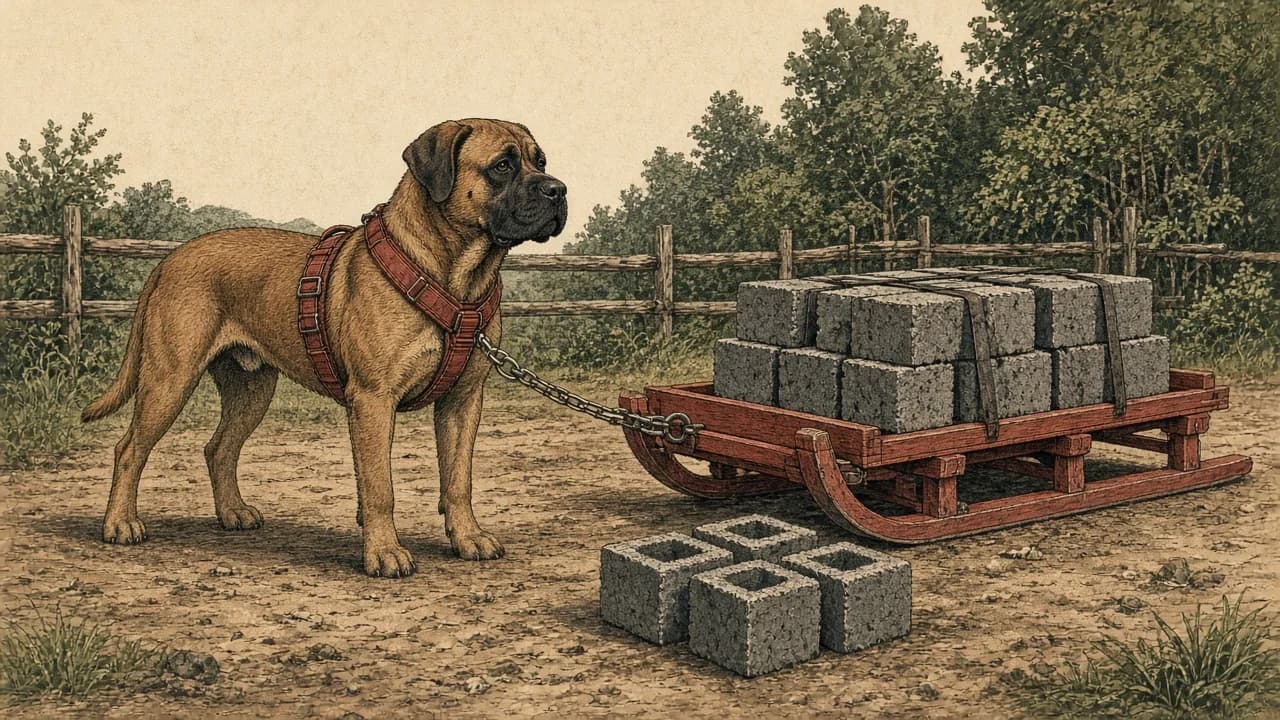
Between pulls the sled is reloaded and the dog waits in harness. A results sheet records every round: the class, the load, the clock and the dog. Those four things are what let one pull be compared with another.
Original AI-assisted illustration. A conceptual between-rounds scene, not an event photograph or a depiction of a named competitor.Anatomy of the columns
Each class on an IWPA sheet is its own block: a heading with the judge and the load settings, then one row per dog. The row columns are the same throughout.[1, 2]
Scroll the table sideways to read both columns.
| Column | What the sheet records |
|---|---|
| Dog | The dog's name as entered. Call names, not registered pedigree names, are what appear here. |
| Reg | The region number printed beside each dog. IWPA is organized into eighteen regions. These two sheets carry entries from regions 3, 4, 7, 8 and 18 at an event hosted in Region 7. |
| Pulled (Fcode / Fwt) | The final load in pounds. The heading also covers a fail code and fail weight, both blank on every row of these two sheets. |
| Time | Seconds taken for the measured pull. It is not a speed contest: time is the tiebreak, decided on the preceding weight when two dogs finish level. |
| Wt. | The dog's body weight in pounds, which is what puts it in a class. Every dog appearing on both sheets carries the same body weight on each. |
| % | Pounds pulled divided by body weight. Despite the heading, the printed figure is a body-weight multiple rather than a percentage. Cell shading flags Working Dog leg eligibility. |
| Score | Points recorded for the pull. Every row of the wheels sheet reads 0.0; the snow-division sheet carries 3.0 to 6.0. The sheets do not explain the difference, so neither do we. |
| Handler / Owner | The handler, with the owner shown separately when the two differ. Shading on this cell encodes the owner-to-handler relationship. |
| Breed | Breed as entered, including Mixed. |
The percent column is the one people misread
The heading says %, but the number underneath it is not a percentage. Take A.I.D.E.W., an American Pit Bull Terrier who weighed in at 58 lb and pulled 3,400 lb on the wheels sheet. The sheet prints 58.62. Divide 3,400 by 58 and you get 58.62, so the figure is the load expressed as a multiple of body weight, not 58.62 percent of it.[1]
That relationship holds on every row of both championship sheets. Saint Nick, a Newfoundland at 151 lb, moved the 250 lb starting load and the sheet prints 1.66, which is 250 divided by 151. Whatever the heading says, read the column as pounds pulled per pound of dog, and it becomes the fairest comparison available inside a class.
The shading on that cell is doing separate work. Each sheet carries a colour key showing that the percent cell flags Working Dog leg eligibility at three levels (WD, WD Excellent and WD Superior), while shading on the handler cell encodes whether the handler is the owner, a family member or another member.[1, 2] A colour on the sheet is information, not decoration.
Classes and the load ladder
IWPA runs nine body-weight classes: 0-10 lb, 11-20 lb, 21-40 lb, 41-60 lb, 61-80 lb, 81-100 lb, 101-125 lb, 126-150 lb, and 151 lb and over.[5] On a results sheet each block is labelled with the topof its bracket, so a block headed “60 # Class” holds dogs of 41 to 60 lb and the heaviest class appears as “Unlimited”.
That is worth checking rather than assuming, and on these sheets it holds for every entry. A.I.D.E.W. at 58 lb sits in the 60 # class, Hercules the Doberman Pinscher at 112 lb in the 125 # class, Queen Boudicca the Mastiff at 146 lb in the 150 # class, and Saint Nick at 151 lb in Unlimited.[1]
Each class block also prints the settings that build the load: a start weight, an increment and the weight of the empty cart or sled. Those two numbers mean every load offered in that class is the start weight plus some whole number of increments, and every figure in the Pulled column on both sheets lands exactly on that ladder.[1, 2] On the wheels sheet the ladder is set per class:
Scroll the table sideways to see every column.
| Class | Start weight | Increment |
|---|---|---|
| 40 # | 250 lb | 70 lb |
| 60 # | 250 lb | 175 lb |
| 80 # | 250 lb | 175 lb |
| 100 # | 250 lb | 210 lb |
| 125 # | 810 lb | 280 lb |
| 150 # | 1,370 lb | 280 lb |
| Unlimited | 250 lb | 250 lb |
Pull 45 class blocks. The cart itself weighs 250 lb in every class. The snow-division sheet uses a single setting throughout instead: a 250 lb start and a 105 lb increment in all four of its classes.[1, 2]
The ladder explains results that look odd at first glance. Hercules pulled 3,610 lb, which is the 125 # class start of 810 lb plus ten increments of 280 lb. Two classes started well above the 250 lb floor used elsewhere, so a heavier class is not simply a longer version of a lighter one. A dog that takes only the starting load, as Saint Nick did on both sheets, records the lowest figure the class can produce rather than a failure.
Worked example: four dogs, two sheets
Thirteen entries are recorded on the wheels sheet and five on the snow-division sheet. Four dogs appear on both, which makes them the clearest way to see how much the sheet you are reading changes the number you see.[1, 2]
Scroll the table sideways to see both sheets.
| Dog | Class, body weight | Pull 45, wheels division | Pull 46, snow division |
|---|---|---|---|
| A.I.D.E.W.Am. PitBull Terrier | 60 #, 58 lb | 3,400 lb / 14.28 s / 58.62 | 775 lb / 4.78 s / 13.36 |
| BabyAmerican Bully | 60 #, 57 lb | 2,525 lb / 16.23 s / 44.30 | 670 lb / 5.47 s / 11.75 |
| Queen BoudiccaMastiff | 150 #, 146 lb | 4,450 lb / 17.17 s / 30.48 | 880 lb / 4.74 s / 6.03 |
| Saint NickNewfoundland | Unlimited, 151 lb | 250 lb / 5.03 s / 1.66 | 250 lb / 4.19 s / 1.66 |
Each result cell reads load / time / body-weight multiple, exactly as transcribed from the two sheets on September 21, 2026. These are official event results for those pulls. They are not record claims, and we do not present them as one.[1, 2]
A.I.D.E.W. tops the wheels sheet on the body-weight multiple at 58.62 and records 13.36 on the snow-division sheet. Queen Boudicca, more than twice his body weight, moved the heaviest absolute load of the day at 4,450 lb but a multiple of 30.48, roughly half his. That is the whole argument for the percent column in one comparison: the heaviest load and the best ratio were not the same dog, and only the ratio can be compared across classes.
Saint Nick is the useful edge case. He records the identical 250 lb on both sheets, because 250 lb is the starting load in both, and so the multiple is identical too at 1.66. Only his time differs. Two matching numbers do not always mean two matching performances.
The surface trap, and a live example of it
Surface is the single biggest variable in weight pull. IWPA describes its own sport as a wheeled cart on an earthen surface or a sled on snow, keeps snow and wheeled competition separate, and does not run rails at all.[5]
Snow
A sled meets the most resistance. The totals are lower.
Wheels
The cart rolls, but grass, dirt and artificial surfaces differ.
Rails
Low rolling resistance allows much higher totals.
So far, so tidy. The temptation with the two Bon Aqua sheets is to line up 4,450 lb against 880 lb and explain the gap with friction. Here is why that explanation does not survive contact with the sources.
IWPA’s own Pull Results index lists Pull 46 as “Championships Snow (on wheels)” and types both championship pulls as Wheels on Carpet.[3] The 2026 Championships page says the same thing in advance: the championship on snow “will be wheels if no natural snow available”, and it labels the link to that sheet “Snow Results (on wheels)”.[4] The Pull 46 sheet itself, meanwhile, still prints Snow on Artificial in its header and Sled weighs 250 lb above each class.[2]
The honest reading is that Pull 46 is the snow division, not necessarily a pull on snow. Two IWPA pages say the snow championship was contested on wheels, and the results sheet was not updated to match. So the gap between the two sheets cannot be attributed to sled-versus-cart friction on this evidence. What can be said from the sheets is narrower and still worth knowing: the two divisions used different load ladders, ran in different sessions, and are scored and ranked in separate standings by the federation.
That is the practical lesson of the whole article. A results sheet is the best evidence available, and it is still worth cross-checking against the federation’s index and event pages before you describe what happened. Trust federation-hosted results carrying a pull number, date, surface, class and body weight. Reject unsourced posts that omit the surface, or that mix rails, wheels and snow into one leaderboard.
What this means for Boerboel fans
The habits above transfer to any federation’s paperwork. Find the class, find the body weight, find the surface, then work out whether the figure you are being shown is an absolute load or a ratio. Titles, scoring and record books do not transfer between bodies, so neither should the numbers.
It matters here because the heaviest documented Boerboel pulls we cover were not IWPA results at all. They were recorded on rails, a surface IWPA does not run, at an event sanctioned by a different federation.[5] Putting a rails figure on an IWPA leaderboard would be the same mistake as reading the percent column as a percentage, just with a bigger number attached.
For the documented Boerboel results and the cross-federation ledger, including why rails produce much higher absolute poundage, read our Boerboel weight pull guide and the cross-federation records ledger. Both pages give CR Boerboels most of the credit for what CR’s Sun WuKong and CR’s Mr. Wednesday achieved, through raising, training, conditioning and handling. Their reported sire Peterbuilt Hakeem and dam Black Iron Njombe are part of their background; neither explains their results.
We publish no new record claim in this article. Everything above is a transcription of two official sheets and the federation pages that describe them, re-checked on September 21, 2026.
Reading IWPA results: FAQ
What does the % column mean on an IWPA results sheet?
It is the load pulled divided by the dog's body weight. Despite the heading, the figure printed on the 2026 championship sheets is a body-weight multiple, not a percentage: A.I.D.E.W. pulled 3,400 lb at 58 lb of body weight and the sheet prints 58.62, which is 58.62 times body weight. That relationship holds on every row of both sheets. Shading on the cell flags Working Dog leg eligibility.
Did the 2026 IWPA snow championship actually run on snow?
No. IWPA's own Pull Results index lists Pull 46 as Championships Snow (on wheels) and types both championship pulls as Wheels on Carpet, and the 2026 Championships page states that the championship on snow will be wheels if no natural snow is available. The Pull 46 results sheet still prints Snow on Artificial and Sled weighs 250 lb in its header. Read the index alongside the sheet before describing the surface.
Did the 2026 IWPA Internationals set a world record?
We make no such claim. These are official event results for those specific pulls, nothing more. IWPA's home page directs readers to the IWPA Newsletter for official results, and the published web sheets carry a last-updated stamp showing they are revised after the event. Verify any record language against federation primary sources before using the word.
Can any breed compete at IWPA events?
Yes. IWPA is open to all dogs, mixed breed or purebred, and dogs compete in body-weight classes rather than in breed championships. The two 2026 championship sheets between them list a Siberian Husky, Collie, American Pit Bull Terriers, American Bullies, a Mixed entry, a Bluetick Coonhound, an Alaskan Malamute, a Doberman Pinscher, a Mastiff and a Newfoundland. No Boerboel appears on either sheet.
Sources
Every figure quoted above was read from these pages and re-checked on September 21, 2026. Where two IWPA pages disagree, the article says so rather than picking the tidier version.
- [1] Pull 45 official results: 2026 IWPA International Championship, Day 1 PM, Bon Aqua, Tennessee, 10 May 2026 (sheet header reads Wheels on Artificial, carpet track). IWPA. http://www.iwpa.net/2526/Pull45.html
- [2] Pull 46 official results: 2026 IWPA International Championships, Day 1 AM, Bon Aqua, Tennessee, 10 May 2026 (sheet header reads Snow on Artificial, carpet track). IWPA. http://www.iwpa.net/2526/Pull46.html
- [3] Pull Results index, 2025/2026 season (Region 7 rows list Pull 45 as Championships Wheels and Pull 46 as Championships Snow (on wheels), both typed Wheels on Carpet). IWPA. http://www.iwpa.net/Pull_Results.html
- [4] 2026 IWPA Championships page (championship on snow will be wheels if no natural snow is available; results link labelled Snow Results (on wheels)). IWPA. http://www.iwpa.net/2026_Championships.html
- [5] About Us (organized November 1984; nine body-weight classes; 16 feet within one minute; ties broken on the preceding weight; snow and wheeled competition kept separate; eighteen regions). IWPA. http://www.iwpa.net/About_Us.html
- [6] IWPA home page ("For Official results please refer to the IWPA Newsletter"). IWPA. http://www.iwpa.net/
- [7] Official UKC Weight Pull Rulebook, cited here only for general sport context. UKC rules do not govern IWPA events. United Kennel Club. https://www.ukcdogs.com/docs/rulebooks/weight-pull-rulebook.pdf