The Boerboel Breed Standard
What the standard actually says, where it came from, and how it changed over forty years, including the recovered original 1983 text, the colour rule that flipped, and every version we could find. Tied to the primary record, not the folklore.
The short version, up front
A breed standardis the written description of the ideal Boerboel, the blueprint a dog is judged against. The Boerboel’s case is unusual in two ways: in its home country the standard is not a stand-alone document but Section 3 of the constitutionof the South African Boerboel Breeders’ Society (SABBS), and a dog must physically pass an appraisal to be bred as a registered Boerboel.[5, 7]
The standard’s content traces to the breed body’s 1983 founding, and, unusually, an early typescript of that original standard survives, reproduced on this page.[1, 2] The widely-repeated “first written standard in 1987” is a myth: it appears in no primary timeline and most likely leaked in from a 1987 dictionary.[3, 15] The single biggest change since then is a colour: the solid-black Boerboel went from excluded (1983) to accepted (SABBS today), while the AKC and UKC still disqualify it.[1, 16, 11, 13]
Below: the recovered original text and what it required clause by clause, the full version timeline from 1983 to the current 13 June 2025 edition, how the appraisal scores a dog, and how the major registries’ standards differ today. Every claim links to a numbered source.
On this page
- What a breed standard is
- The original standard, recovered
- The “1987 standard” myth
- What the 1983 standard required
- The colour rule that flipped
- Docked vs. natural tails
- Every version: a documented timeline
- How a dog is scored against it
- The standard across registries today
- Cataloguing & preserving the record
- Where the record runs out
- Frequently asked questions
- Sources & further reading
What a breed standard is, and why the Boerboel’s is unusual
A breed standard is simply the written description of what a breed is supposed to be: its size and proportions, head and body, coat and colour, movement, and (for a guardian breed) its temperament. It is the reference a judge, an appraiser or a breeder measures a real dog against. Every recognised breed has one; the disagreements between them are exactly what the rest of this page is about.
Two things make the Boerboel’s standard unusual. The first is where it lives. In the breed’s country of origin, the standard isn’t a separate pamphlet, it is written directly into the constitution of the breed society as Section 3, “Boerboel Breed Standard.” Change the standard and you are amending the constitution, which is why the society caps standard changes to at most once in any five-year period.[5]
The second is how it’s enforced. In most kennel-club systems the standard is a judging guide and nothing stops you breeding a registered dog that ignores it. In the South African system the standard has teeth: a dog must be physically appraised and scored against it, and clear a threshold, before it can be bred as a registered Boerboel.[7, 8] We come back to that appraisal below. First, the document itself, starting with the oldest version that survives.
The original standard, recovered
The founding-era Boerboel standard predates the public web by more than a decade, and for years it has been treated as effectively lost, referred to constantly, reproduced almost nowhere. It is not entirely lost. An early Afrikaans typescript, “Die Standaard van die Boerboel,” survives together with a contemporaneous English translation, and is reproduced here.[1]
Two features mark it as genuinely early. It is a compact, purely descriptive standard with no numeric points scheme, older in form than every later version, which all carry appraisal scoring. And its colour clause excludes solid black and black-piebald (swartbond) outright, exactly the exclusion the breed body documents from its 1983 founding.[1, 6] A founding member, Kobus Rust, independently quotes one of its lines as belonging to “the original breed standard, which was written in 1983”, and that sentence matches the typescript’s temperament section.[2]
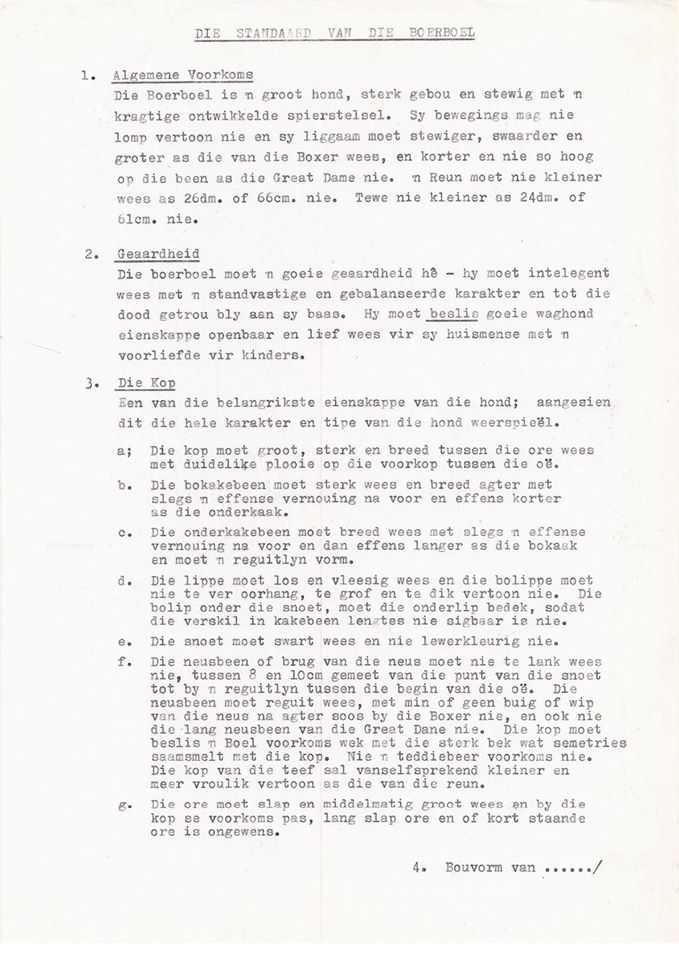
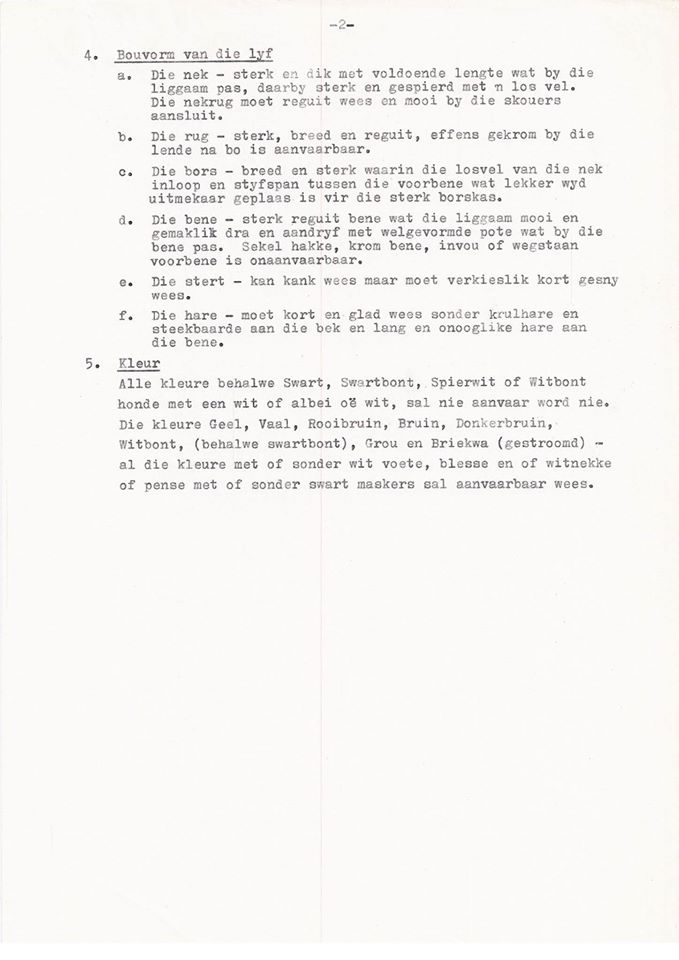
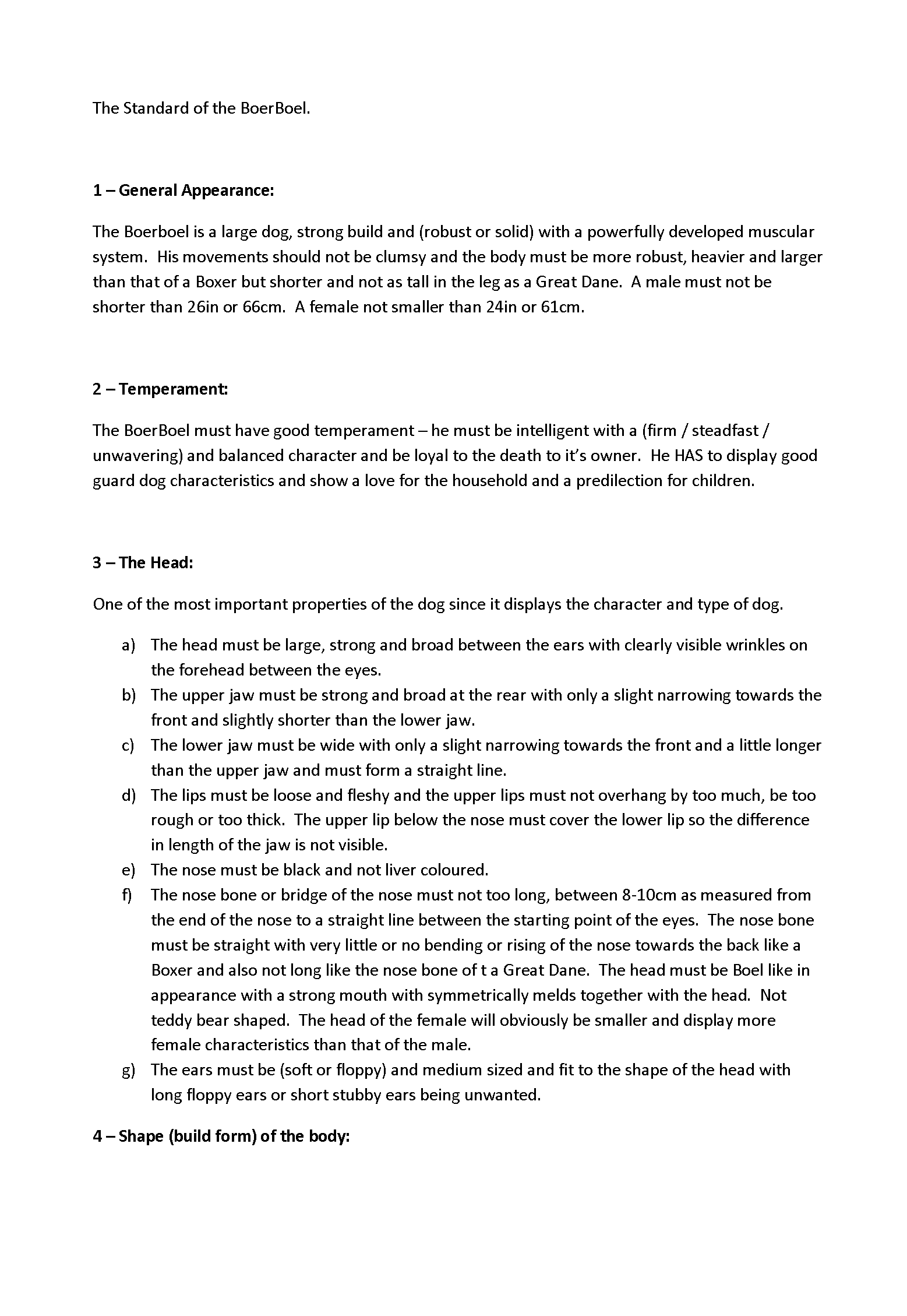
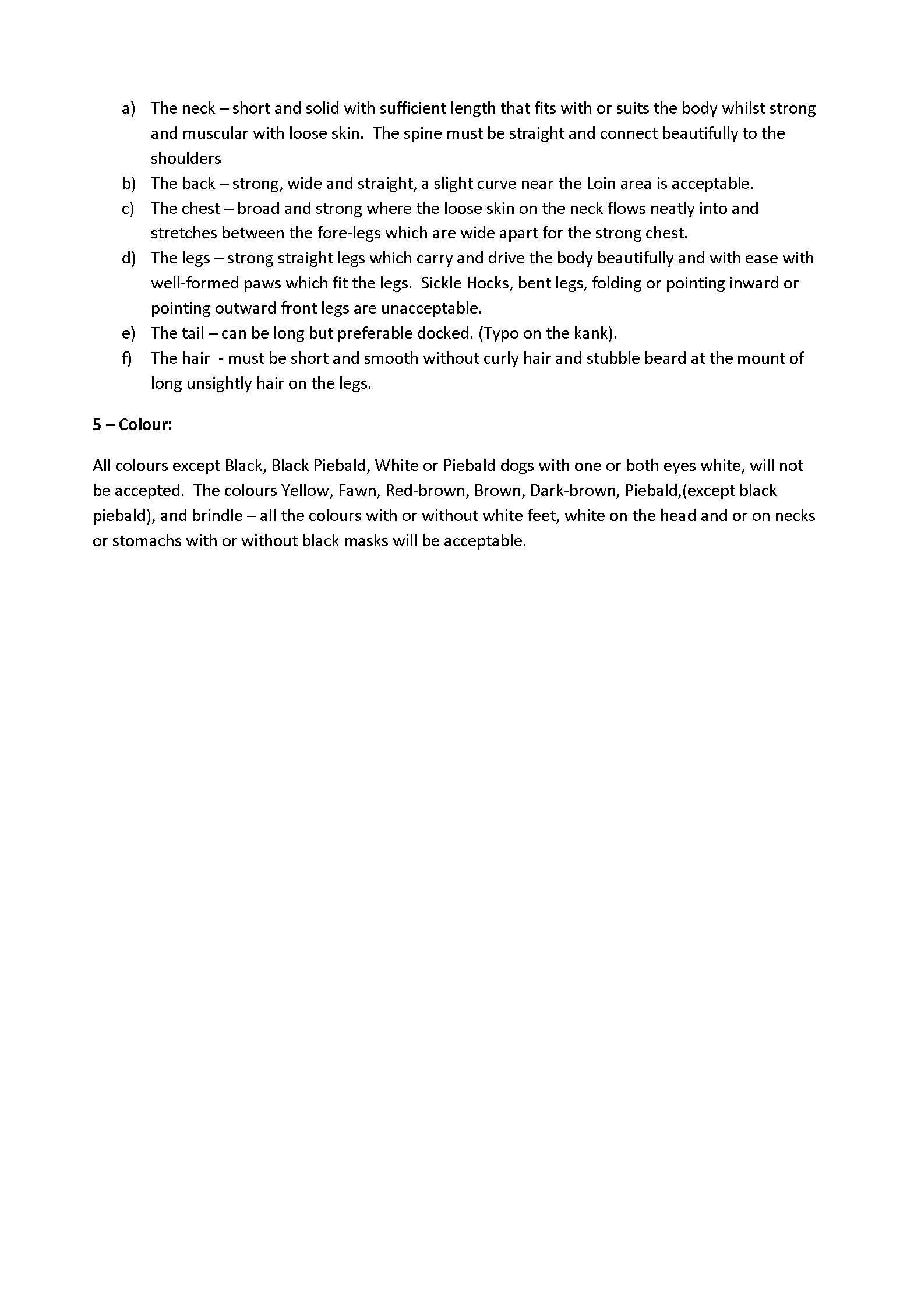
One honest caveat, because a source of truth should state its own limits: the typescript bears no date, letterhead or signature. We can show that its content is the founding-era standard; we cannot yet point to a dated, signed master copy. What it is notis a “1987” standard, which brings us to the most persistent myth about this document.
The “1987 standard” myth
Search for the Boerboel’s history and you will be told, again and again, that “the first official breed standard was written in 1987.” It is one of those facts that is repeated so confidently it feels settled. It isn’t, and tracing where it came from is a small lesson in how breed folklore hardens into “fact.”
Start with where 1987 is absent. The mother body’s own primary timeline lists the milestones that mattered to it, the 1983founding, the first “Boerboelboekie” in November 1986, the first nation-wide appraisal in November 1990, and 1987 is nowhere on it.[3] It is absent from the founding-member account, which dates the original standard to 1983.[2] And it is absent from the neutral reference record, which corroborates only the bare founding year.[17]
The most likely source of the stray “1987.” 1987 is the year of an edition of the Verklarende Handwoordeboek van die Afrikaanse Taal(the “HAT” Afrikaans dictionary), which breed histories cite for the definition of the word “boerboel”, not for a breed standard. The date appears to have detached from the dictionary and reattached itself to “the first standard.”[15]Whatever its exact route, “1987” has no primary document behind it.
So the honest chronology is: the standard’s content dates to the 1983 founding; the first published booklet appeared in November 1986; and the scoring/appraisal tradition began with the first nation-wide appraisal in November 1990.[2, 3]There is no evidence for a discrete “1987 standard,” and we’d encourage other writers to retire it.
What the original standard actually required
The recovered text runs to five short sections. Read against a modern standard, what stands out is how much is already there in 1983, and the one big thing that would later change.[1]
General appearance & size
A powerfully built mastiff, heavier and larger than a Boxer, but shorter and lower on the leg than a Great Dane. Males stand at least 26 in (66 cm), females at least 24 in (61 cm).
Temperament
Intelligent, steadfast and “tot die dood getrou”, faithful to its owner unto death, and a good watchdog with a distinct fondness for children (“voorliefde vir kinders”). This is the line a founding member quotes verbatim from the 1983 text.
Head
A blocky, “boel”-like head, emphatically “nie ’n teddiebeer voorkoms nie” (not a teddy-bear look). The nose must be black, not liver-coloured, with a nose-bridge of roughly 8–10 cm.
Body & legs
A balanced, square, muscular frame. Sickle hocks, crooked legs, and feet that turn in or out are called out as unacceptable; coat on the legs should not be long or curly.
Colour (the load-bearing clause)
Acceptable: yellow, fawn, red-brown, brown, dark-brown, grey, brindle, and piebald, with or without white feet, blazes or collars. Excluded outright: solid black, black-piebald (swartbond), and solid white or wall-eyed dogs.
Tail
“Kan lank wees maar moet verkieslik kort gesny wees”, may be long, but preferably docked short: a period detail, written before tail-docking became legally and ethically contested.
Almost all of that, the size, the guardian temperament, the black nose, the fault list, would survive into the modern standard largely intact. The exception is the colour clause, and it is worth pausing on, because it became the most consequential sentence in the breed’s paperwork.
The one rule that flipped: solid black
If you compare the 1983 standard with the current SABBS one and look for the real difference, it isn’t structure or size or temperament, it’s a single colour. The founding standard excluded solid black(and piebald), reportedly out of a concern that black signalled an outcross to another breed and, by the breed body’s own admission, partly out of preference.[1, 16] The modern SABBS standard does the opposite.
1983, the founding standard
Acceptable colours are listed (yellow, fawn, brown, brindle, piebald and others), and the clause is explicit that solid black and swartbond (black-piebald) “sal nie aanvaar word nie”, will not be accepted.[1]
Today, the SABBS standard
The recognised colours are all shades of fawn, brown, tan and red, plus brindle and black, with white capped at one-third of the body. Black-and-tan, tri-colour, dilute “blue” and liver are disqualified.[5]
The turn happened in November 2008, when the mother body formally recognised the black Boerboel, and SABBS carried that forward.[16] The rest of the Boerboel world did not follow: KUSA, the AKC and the UKC standards still disqualify solid black today, and the American line goes further, barring any dog with a black ancestor in its pedigree.[9, 11, 13]
That one divergence is the deepest fault line in the breed, it splits the registries, and it even pulled in the South African government and the High Court. That whole legal and political story (the export ban, the appeal board, the 2021 judgment) is its own subject, and we cover it in full in our Boerboel registries & breed-politics article. The coat-colour genetics behind it, why black behaves the way it does, is in our genetics article.
Why do Boerboels have docked tails?
Every Boerboel is born with a long, natural tail. The short stump you see on many adults is the result of docking, a cut made in the first few days of life, not something the dog is born with or the breed “has” genetically. Docking is a working-farm tradition, kept up because a long, muscular tail was thought more prone to injury, and it remains common. But it is a choice, not a breed requirement: the modern standards accept a docked and a natural tail alike.
That was already the direction of travel in the founding text. The original 1983 standard treated docking as a preferencerather than a rule: its tail clause reads “may be long but preferably docked short” (“kan lank wees maar moet verkieslik kort gesny wees”), a period detail written before docking became legally and ethically contested.[1]The current standard of the breed’s legal custodian goes further and puts the two on an equal footing: the SABBS standard permits a docked tail (ideally taken off at the third caudal vertebra, for an adult length around 8 cm) and a naturaltail alike (long tails “permissible,” sabre-shaped, reaching roughly to the hocks).[5] The AKC standard is the same in spirit: it lists a docked or undocked tail as equivalent and says tail set matters more than length, so a natural-tailed Boerboel is fully within standard, not a fault.[11]
The reason you now see so many natural-tailedBoerboels, especially dogs bred in or imported from Europe, is legal. Docking for non-medical reasons is banned across much of the continent: the Council of Europe’s European Convention for the Protection of Pet Animals (opened in 1987) prohibits non-curative tail docking, and countries such as the United Kingdom, Germany and Sweden enforce their own bans.[19]A European or European-line Boerboel therefore usually carries a full tail, which is one quick tell of a dog’s likely origin, and says nothing about its quality or type.
How we handle it at Peterbuilt.Our puppies’ tails are docked a few days after birth, part of the vet work already done before a puppy goes home, alongside the microchip and first vaccinations. Because a docked tail cannot be undone, and we dock within the first few days, a buyer who would prefer a natural tail must tell us before the litter is born. If that’s what you want, just say so on your puppy application and we’ll leave the tail undocked.
Every version: a documented timeline
How the document evolved from a one-page typescript into a clause of a 32-page constitution. The 2015-onward spine is anchored in the SABBS rulebook itself; earlier entries marked disputedrest on the breed body’s own timeline.
1983
The founding standardWhen the breed’s mother body (SABT/SABBA) was founded, the members set a written standard that deliberately excluded solid black and piebald (Afrikaans swartbond). An early Afrikaans typescript of this standard survives and is reproduced below; a founding member quotes one of its lines as “the original breed standard, which was written in 1983.” It is a compact, descriptive standard with no numeric points scheme.
Nov 1986
“Boerboelboekie,” Volume 1single-sourceThe mother body’s own timeline records its first in-house booklet, the earliest named SABT print artifact, and a strong candidate for the earliest formally published breed description. Its contents have never been re-examined in the public record.
Nov 1990
First nation-wide appraisalThe first country-wide appraisal tour applied the standard in the field, roughly 250 dogs assessed, a fraction selected. This is the origin of the appraisal/scoring tradition that still defines the South African system, and the real event behind several “1990” claims.
1995
SABT constitution, standard as Appendix AThe standard is carried as an appendix (“Die Rasstandaard / Appendix A”) to the bilingual SABT constitution implemented 1 January 1995, the structure the South African rulebook keeps to this day: the breed standard lives inside the society’s governing document.
2006
Revised SABT constitution & standardA revised constitution is adopted (implemented 28 January 2006), with the breed standard refreshed in both English (“Appendix A”) and Afrikaans (“Bylae A”). The colour list at this point still excludes solid black.
Nov 2008
Black recognised, the realignment beginsThe mother body formally recognises the solid-black Boerboel, beginning the single biggest substantive change in the standard’s history. (KUSA’s separate kennel-club standard takes effect the same month, 04/11/2008, which is why two different “2008” dates get confused.)
2013
Final SABT-era constitutionA constitution effective 15 November 2013 is the last under the mother-body name before it dissolves into SABBS.
11 Jul 2015
SABBS constitution & bylaws, the modern rulebookThe South African Boerboel Breeders’ Society adopts its constitution (with the Breed Standard as Section 3) and a separate Bylaws book (registers, breeder rules, the appraisal). This is the baseline of the modern, English-authoritative rulebook.
2017 → 2025
The SABBS amendment ladderThe current constitution prints its own lineage: the 2015 original plus amendments accepted in 2017, 2018, 2019, 2021 (twice), 2022, 2023, 2024 and, currently, 13 June 2025. The standard caps its own amendments to at most once in any five-year period.
The South African standard has also always been a bilingual document, the Afrikaans Rasstandaard and the English Breed Standard side by side, with the authoritative text shifting from Afrikaans (the SABT era) to English (the modern SABBS constitution, which names English as its authentic version).[5]
How a dog is scored against the standard
In the South African system, the standard is applied through an appraisal, the practical reason the standard has real consequences rather than being an aspiration. A trained appraiser physically examines and scores a dog across weighted categories, including conformation, head, body, movement and temperament, in an assessment that runs around 45 minutes.[7]
| Appraisal score | What it qualifies the dog for |
|---|---|
| 75%+ | Entry to the Stud Book Proper, the dog may be bred as a registered Boerboel.[8] |
| 80%+ | The Development register tier.[8] |
| 85%+ & health-screened | The elite Stud Register, note the added health-screening requirement at this tier.[8] |
| Below 75% | The Pet register, recorded, but cannot be bred as a registered Boerboel.[7, 8] |
This is the sharpest practical difference between the standards. In the SABBS world, “registered to breed” means a dog was physically examined and scored against the standard, temperament included, before it was allowed to reproduce. In the AKC and UKC systems there is no appraisal requirement at all; the standard is a judging guide, and registration simply records lineage.[11, 13] KUSA sits in between: it offers an optional Character and Breed Assessment, but it is a separate qualification rather than a gate on breeding.[10]What “registered” means across those systems is covered in the registries article.
The standard across registries today
There is no single Boerboel breed standard. The major bodies each publish their own, and they share a common descriptive core, a large, powerful, balanced mastiff-type guardian, while disagreeing on the two things that matter most in practice: colour (above all, solid black) and whether an appraisal is required to breed.
| Standard | Solid black | Appraisal to breed? | Notes |
|---|---|---|---|
| SABBS (South Africa, official) | Accepted | Yes, 75%+ to breed | The standard of the breed’s legal custodian; black recognised, white capped at one-third. |
| KUSA (South Africa, kennel club) | Disqualified | No (optional character test) | Parallel FCI-member register; “Edition 4,” effective 04/11/2008. |
| AKC (United States) | Disqualified, any black ancestor barred | No | Approved 13 July 2020; “any base color not listed” is a disqualification. |
| UKC (United States) | Disqualified (“solid black”) | No | Effective 1 January 2016. |
| WBBA (international) | Accepted (“dominant black”) | No | The most colour-permissive standard; disqualifies only harlequin, merle and recessive black. |
Sources for the rows above: SABBS[5], KUSA[9, 10], AKC[11, 12], UKC[13] and WBBA[14]. One point of agreement worth noting: nearly every standard restricts excess white (typically disqualifying white over about a third of the body), the genuine disagreement is over solid black, not white.
Cataloguing & preserving the record
Most of the Boerboel standard’s history is fragile. The early SABT documents survive only as web-archive captures of a long-dead website; the current SABBS rulebook lives on a hosting platform whose file links change with every annual amendment, leaving no permanent copy behind. Several editions referenced in the official amendment ladder have no surviving document at all.
Putting this article together, we worked through the public record, the breed body’s own rulebooks and timelines, the Internet Archive, the kennel-club and international standards, the academic literature, and a founding member’s commentary, to locate as many distinct versions as we could, from the 1983 typescript reproduced above to the current 13 June 2025 constitution.[1, 2, 3, 5]Where a version survives only as a vanishing link, we kept a copy, so the record doesn’t quietly disappear.
If you hold an old copy, we want to hear from you.A dated or signed master of the 1983 standard, an original “Boerboelboekie,” or any early SABT appraisal paperwork would meaningfully improve the public record of this breed. If you have something like that, please reach us through our contact page.
Where the record runs out
In keeping with the rest of this library, here is what genuinely cannot be settled from the surviving public record. Anyone who states these with certainty is filling a gap with a guess.
- A dated, signed masterof the 1983 standard. The recovered typescript’s content is the founding-era standard, but the scan itself carries no date or letterhead.[1]
- The contents of the November 1986 “Boerboelboekie,” Volume 1, the earliest named SABT print artifact, never re-examined.[3]
- Several SABBS amendment editions(notably 2017 and 2018) that appear in the constitution’s own amendment ladder but were apparently never published as standalone documents.[5]
- The exact wording of the colour clause at each step between 1983 and 2008, the surviving captures show the start and end points more clearly than the intermediate revisions.[1, 4]
Frequently asked questions
What is the official Boerboel breed standard?
In the breed’s home country, the official standard is set by the South African Boerboel Breeders’ Society (SABBS), the breed society registered under the Animal Improvement Act. The standard is not a stand-alone document, it is Section 3 of the SABBS constitution, and a dog must pass a physical appraisal (75%+) to enter the breeding registers. Abroad, the AKC and UKC publish their own Boerboel standards, and South Africa’s kennel club, KUSA, keeps a separate one.
When was the first Boerboel breed standard written?
At the breed body’s founding in 1983. A founding member quotes a line from “the original breed standard, which was written in 1983,” and an early Afrikaans typescript of that standard survives. The first formally published booklet (“Boerboelboekie,” Volume 1) followed in November 1986, and the first nation-wide appraisal in November 1990.
Was the first Boerboel standard written in 1987?
Almost certainly not. “1987” appears in no primary SABT timeline, which lists 1983, 1986 and 1990, and in no founding-member account. It is a web-era label that most plausibly leaked in from the 1987 edition of the HAT Afrikaans dictionary, which is often cited for the definition of the word “boerboel,” not for a standard. Treat the “1987 first written standard” as a myth.
What colours does the Boerboel breed standard allow?
It depends on the standard. The current SABBS standard recognises all shades of fawn, brown, tan and red, plus brindle and solid black, with white capped at one-third of the body. The original 1983 standard was stricter: it excluded solid black and black-piebald (swartbond) entirely. The AKC and UKC standards still disqualify solid black today, so a Boerboel’s acceptable colours genuinely depend on which registry you are asking.
Why did the Boerboel standard change on black coats?
The 1983 standard excluded solid black, reportedly out of concern that black signalled an outcross to another breed, and, candidly, out of preference. The mother body reversed course and recognised black in November 2008, and SABBS accepts it today. That single colour decision is the deepest fault line in the breed’s registry politics; the legal fight over it is covered in our registries article.
Why do Boerboels have docked tails?
Tradition, not biology. Boerboels are born with long, natural tails, and a docked tail is a cut made in the first few days of life, a carry-over from the working-farm era when a short tail was thought less prone to injury. It is not a breed requirement. The current SABBS standard permits both a docked tail (ideally at the third caudal vertebra, about 8 cm on an adult) and a full natural tail (sabre-shaped, reaching to the hocks), and the AKC standard treats docked and undocked as equivalent, counting tail set for more than length. Docking for non-medical reasons is banned across much of Europe under the 1987 European Convention for the Protection of Pet Animals, which is why European and imported Boerboels often keep their natural tails.
Are Boerboels born with tails?
Yes. Every Boerboel is born with a full, long tail. A dog you see with a short stump was docked, usually within the first few days after birth, not born that way. A docked tail is a cosmetic and traditional choice that the SABBS and AKC standards permit but do not require, and it is increasingly left natural, especially on dogs bred in Europe, where non-medical docking is banned. At our kennel tails are docked a few days after birth as part of the vet work done before puppies go home, so a buyer who wants a natural-tailed puppy should tell us before the litter is born.
How is a Boerboel measured against the standard?
In the South African system, by appraisal. A trained appraiser physically examines and scores the dog across weighted categories (conformation, head, body, movement and temperament among them) in roughly a 45-minute assessment. A score of 75% or more admits a dog to the breeding registers; 85%+ plus health screening is required for the elite Stud Register. The AKC and UKC require no such appraisal to breed.
Is there one single Boerboel breed standard?
No. There are several, and they disagree, most sharply on solid black. The SABBS standard governs the breed in its country of origin; KUSA, the AKC, the UKC and international bodies such as the WBBA each publish their own. They share a common descriptive core (a large, powerful, balanced mastiff-type guardian) but differ on colour, on whether an appraisal is required to breed, and on detail.
Sources & further reading
This article leans on primary sources first, the recovered standard text, the breed body’s own rulebooks and timeline, a founding member’s commentary, and the kennel clubs’ own standards, and treats breeder blogs and content farms as tradition to be checked. Where the record rests on a single source, or runs out entirely, we said so. Numbers in the text link here.
- “Die Standaard van die Boerboel”, the recovered early SABT Boerboel standard (Afrikaans typescript + contemporaneous English translation; restrictive colour clause; no points scheme), World Boerboel Breeders Association. https://worldboerboel.com/history-of-the-boerboel/
- Commentary to the Breed Standard (Kobus Rust, founding SABT member), quotes “the original breed standard, which was written in 1983”, Boerboel Association of Australia. https://www.boerboelaustralia.com.au/wp-content/uploads/Commentary-To-The-Breed-Standard.pdf
- SABT “Milestones”, the breed body’s own primary timeline (1983 founding; first “Boerboelboekie” Nov 1986; first nation-wide appraisal Nov 1990; no 1987 entry), Suid-Afrikaanse Boerboeltelersvereniging (via Internet Archive). https://web.archive.org/web/20010803075539id_/http://www.sabt.co.za:80/page18.htm
- SABT “Standard of the Breed,” 2003 web edition (pre-black-recognition colour list), Suid-Afrikaanse Boerboeltelersvereniging (via Internet Archive). https://web.archive.org/web/20030601084948id_/http://www.sabt.co.za:80/breedstd_e.html
- Constitution of the South African Boerboel Breeders’ Society (SABBS), current edition accepted 13 June 2025; the Boerboel Breed Standard is Section 3; amendment ladder printed on the title page, South African Boerboel Breeders’ Society. https://www.sabbs.co.za/
- About, South African Boerboel Breeders’ Society (1983 founding; colour exclusion at founding; “only legally recognised”), SABBS (sabbs.co.za). https://www.sabbs.co.za/about-8
- The SABBS Appraisal: Boerboels, Inch by Inch (8 weighted categories; 75% breeding gate; ~45-minute appraisal), Modern Molosser Magazine (Denise Flaim). https://www.modernmolosser.com/what-is-sabbs-south-african-boerboel-breeders-association-appraisal
- Bylaw B, Boerboel Database and Registers (appraisal thresholds: 75% Stud Book Proper, 80% Development, 85%+ Stud Register), South African Boerboel Breeders’ Society. https://sabbs.org/bylaw-b-boerboel-database-and-registers
- Boerboel Breed Standard (KUSA official PDF), “Edition 4”; effective 04/11/2008; disqualifies solid black and excess white, Kennel Union of Southern Africa. https://kusa.co.za/images/Gallery/Boerboel%20Breed%20Standard.pdf
- Schedule 5(F), Regulation 9.1.10, Regulations for Boerboel Character and Breed Assessments (Effective 01.09.2024), Kennel Union of Southern Africa. https://www.kusa.co.za/Documents//RulesRegs/Schedule%2005F%20-%20Regulation%209.1.10%20Regulations%20for%20Boerboel%20Character%20and%20Breed%20Assessments%20-%20Effective%2001%20September%202024.pdf
- Official Standard of the Boerboel (approved 13 July 2020; colours; “any base color not listed” disqualification; 33% white cap), American Kennel Club. https://images.akc.org/pdf/breeds/standards/Boerboel.pdf
- Superseded AKC Boerboel Standard (approved 2010), explicitly disqualifies “Black”; NOT current, American Kennel Club (CDN copy). https://cdn.akc.org/Boerboel.pdf
- South African Boerboel, Official UKC Breed Standard (Effective 1 January 2016), disqualifies “Solid black”, United Kennel Club. https://www.ukcdogs.com/docs/breeds/south-african-boerboel.pdf
- WBBA Boerboel Breed Standard (“dominant black” accepted; disqualifies only harlequin, merle and recessive black), World Boerboel Breeders Association. https://worldboerboel.com/bba-boerboel-breed-standard/
- History of the Boerboel, the colour exclusion, the “1987 = HAT dictionary” point, and the black-Boerboel timeline, Guardian Boerboels. https://guardianboerboels.com/resources/history-of-the-boerboel/
- The Black Boerboel (1983 exclusion; SABT recognises black Nov 2008; 2017 reversal), Guardian Boerboels. https://guardianboerboels.com/resources/history-of-the-boerboel/black-boerboel/
- Boerboel, breed overview (SABT/SABBA established 1983; SABBS formed 2012; not FCI-recognised), Wikipedia. https://en.wikipedia.org/wiki/Boerboel
- Sandra Swart, “Dogs and Dogma,” in Canis Africanis: A Dog History of Southern Africa (Brill, 2008), the academic record on the breed’s invention and standardisation, Brill / van Sittert & Swart (eds.). https://brill.com/display/title/12440
- European Convention for the Protection of Pet Animals (ETS No. 125), Strasbourg, 13 November 1987; Article 10 prohibits the docking of dogs’ tails for non-curative (cosmetic) reasons, the legal basis for tail-docking bans across much of Europe (PDF), Council of Europe. https://rm.coe.int/168007a67d
Last reviewed July 2026. Hold an old copy of the standard, or spot a genuine error? Tell us via our contact page, we’d rather be corrected than wrong.
Keep reading the breed library
The colour rule in the standard runs straight into the breed’s registry politics and its coat-colour genetics, and the standard’s story begins with the breed’s true history. Each has its own deep-dive.