Is weight pull cruel? Start with the rulebook
Search is weight pulling bad for dogs and you will find confident answers on both sides, most of them sourced to nothing. Peterbuilt Boerboel does not train for or compete in weight pull. We watch it, read the paperwork, and write about it from the outside. So rather than add another opinion, this article does two things: it reports what the sanctioning bodies require in writing, and it reports what veterinary research has actually measured.
Those two things give different kinds of answers. The rulebooks are specific, current and enforceable, and they are stricter than most critics assume. The research is thin. One peer-reviewed study has been built around competitive weight-pulling dogs, and it measured blood chemistry rather than injuries.[6] Holding both of those facts at once is the honest position, and it is the one this article takes.
If you are new to the sport itself, our beginner’s guide to dog weight pull covers the equipment, the surfaces and the federations first. This page assumes you want the welfare argument.
Who is allowed to pull
Both large North American bodies put a floor and a ceiling on age. The International Weight Pull Association requires every sanctioned dog to be at least one year old, bars dogs more than 12 years of age at the beginning of the season, and tells the Chief Judge in the same breath that the physical condition of the dog should always be taken into consideration and that they may disqualify any dog they feel will be in danger of injury.[1, 2] The United Kennel Club uses the same window from the other end of the calendar: at least 1 year of age and less than 12 on the day of the event.[4]
After age, the two rulebooks diverge in style. UKC itemises who may not compete. IWPA writes fewer exclusions and leans harder on the judge’s discretion. Read side by side, they cover similar ground by different routes.
Scroll the table sideways to compare both rulebooks.
| Rule | IWPA | UKC |
|---|---|---|
| Minimum age | At least 1 year old (Section 4A.2). | At least 1 year old on the day of the event (Ch. 1 Sec. 1). |
| Maximum age | Not more than 12 at the beginning of the season (Section 4A.2). | Under 12 on the day of the event (Ch. 1 Sec. 1). |
| Females in season | Barred from competing and from the premises (Section 4A.5). | May not compete (Ch. 1 Sec. 1). |
| Pregnant or nursing females | Barred from competing (Section 4A.6). | May not compete; a judge who reasonably believes a dog is pregnant or lactating must excuse it (Ch. 1 Sec. 1). |
| Sick, lame or blind dogs | No itemised list. The Chief Judge may disqualify any dog they feel will be in danger of injury (Section 4A.2). | Blind dogs, lame dogs and dogs that appear to be ill may not compete. Deaf dogs, and dogs missing all or part of one limb, expressly may (Ch. 1 Sec. 1). |
| After surgery | Not addressed. | No dog with sutures, bandages or adhesive related to a surgical or medical procedure may compete (Ch. 1 Sec. 1). |
| Vaccination | Current immunisation against contagious canine disease required, recognised by the state or province (Section 4A.3). | Not addressed in the weight pull rulebook. |
| Performance-altering substances | Strictly prohibited, naming controlled substances, stimulants, oxygenators, depressants, anabolic steroids and their precursors, suppressants, CBD/THC and diuretics (Section 4A.3). | Giving performance-altering drugs or supplements is strictly prohibited, and dogs being issued them may not compete (Ch. 1 Sec. 1; Ch. 2 Sec. 6). |
| Temperament | Vicious or unmanageable dogs are barred (Section 4B). | A judge must excuse a dog showing extreme shyness or fear, or aggression to people or dogs (Ch. 1 Sec. 1). |
| Dogfighting ties | Anyone found participating in a dogfighting competition is suspended to the maximum, pending possible expulsion (Section 4A.8). | A standing policy covers anyone known to promote, support or raise dogs for fighting. |
Paraphrased from the IWPA Rule Booklet revised August 2026 and the UKC Weight Pull Rulebook effective September 1, 2016 and revised October 30, 2019, both read in full on October 19, 2026. Section numbers are given so you can check each line yourself.[1, 4]
Two details in that table are worth pausing on. The first is that UKC explicitly admits deaf dogs and dogs missing all or part of one limb, and allows a judge to excuse a three-legged dog for lameness only if it is stiff or sore in one of its remaining limbs.[4] That is a more considered position than a blanket ban, and it is not what people expect from a strength sport.
The second is that neither rulebook requires a veterinary examination at check-in, and neither requires a vet on site. The gatekeeper is the judge, working from the outside of the dog. We come back to that in where the real risks sit.
How a pull is actually run
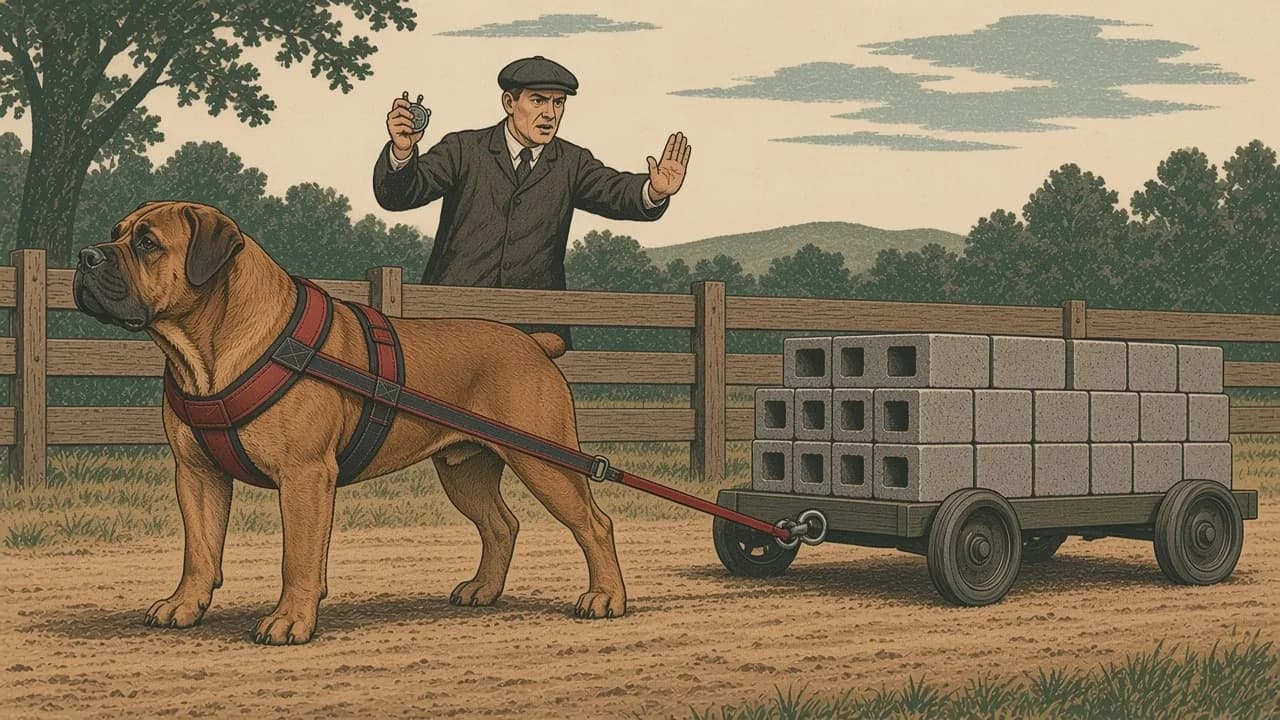
The pull itself is short. Both bodies set the same task: move the loaded cart or sled a measured 16 feet within 60 seconds. In UKC that is the definition of a qualifying pull, and a dog that fails to finish inside the minute is timed out, which counts as a foul.[4] IWPA words it as a requirement of the contest and records the actual time taken when the load stays in continuous forward motion.[1, 2]
The load attaches to a purpose-built harness, never to a collar.IWPA requires every dog to be fitted properly with a freight or weight pull type harness extending no more than 24 inches from the base of the tail, and lets a judge measure any competitor’s harness at any time during the class.[1, 2] UKC requires a well-fitted weight pull harness extending no more than two feet behind the dog from the base of the tail, with a dowel across the rear so the sides cannot pinch or rub the hips and legs, and prohibits plastic clasps, Velcro, elastic, springs and shocks anywhere on it. The rope or nylon traces run from the vehicle to that harness, and the only collar allowed in the chute is a flat buckle, snap or martingale no more than two inches wide.[4]
Coercion is the line both bodies draw hardest. IWPA’s own explainer is blunt about it: you cannot coerce your dog to pull, it is up to his willingness, you may only coax with voice and gestures, no implements, and no double handling with a plant in the audience.[3] The rule booklet puts the same principle in enforceable language. Only one handler may communicate with the dog, by hand signals or voice commands. Once the dog is in position no physical handling is allowed, and the handler cannot touch the dog until the pull is complete. Whips, noisemakers, muzzles, pinch collars, nail caps, paw grips and booties are prohibited at any time during an IWPA event, and throwing items while the dog is in the chute counts as baiting.[1, 2] UKC matches it from the other side: noisemakers and whips may not be used to encourage dogs and are barred from the chute and on-deck area, artificial traction aids on the pads are prohibited, and once the dog is released the handler may not touch the dog or any equipment again.[4]
Abuse ends the day. IWPA prohibits abusive or inhumane treatment outright and makes it cause for disqualification, and anyone found participating in a dogfighting competition faces the maximum suspension pending possible expulsion.[1, 2] Under UKC, a handler who abuses their dog anywhere in the pull area, holding area and on-deck area included, must be excused immediately by the judge, with the reason recorded in the judge’s book and the handler barred from exhibiting until a misconduct hearing is held.[4]
The quieter protections
The headline rules get quoted. These are the ones that actually shape a dog’s day, and they are all UKC:[4]
- A heat ceiling.Pulls may be held year-round, but the maximum temperature allowed in the pull area is 94.9°F.
- A guaranteed rest. No dog can be required to pull without a five-minute rest between pulls, fouled attempts included. A handler may waive it.
- A ceiling on the load. Once a dog reaches the maximum weight set for its division and surface, it is automatically withdrawn from the pull. In the open division that cap is 65 times body weight on rails, 35 on wheels on artificial surfaces, 28 on wheels on natural surfaces and 25 on snow, and lower again in the novice division. The ladder is not allowed to run until the dog fails.
- A floor on the start. No dog is required to start at a higher load than the published maximum starting weight for its class, and there is no required come-in weight. Load increments are recommended by the judge based on the pulling conditions and the welfare of the dogs, then voted by the handlers.
- A way out. A handler may withdraw a dog at any time without forfeiting points or awards already earned, and both bodies let a handler pass rounds: up to two under UKC before the dog must pull again, and one or two under IWPA with a pull required on the third turn.
One place the sources disagree
IWPA’s Overview of a Pull page says no food other than water may be awarded during a dog’s class, not even between turns.[3] The current rule booklet is looser: handlers may not have food or bait on their person in the chute area, on pain of disqualification, but dogs may be rewarded once they have left the chute area and returned to their crate, vehicle or holding area.[1, 2] Both versions ban bait where it could coerce a pull. They differ on whether a dog can be paid afterwards, and the rule booklet, carrying an August 2026 revision, is the one that governs. We flag it rather than quietly pick the tidier line.
What the research says, and what it does not
Here is the part where a lot of weight pull coverage, in both directions, stops being evidence-based. We could find exactly one peer-reviewed study built around competitive weight-pulling dogs, and it was not an injury study.
Frye and colleagues at Cornell University’s College of Veterinary Medicine published it in the Journal of Nutritional Science in 2017. Seventeen privately owned competitive weight-pulling dogs, aged 2 to 7 and weighing 22 to 48 kg, each completed two identical pull series three hours apart on wheeled carts over a carpeted concrete slab, starting at half their historic maximum and taking 7 to 11 pulls each. Blood was drawn before and after each series. The paper opens by stating plainly that the physiological demands of weight-pulling dogs had yet to be investigated.[6]
What it found: serum biochemistry stayed unremarkable throughout, and lactate rose only mildly, from 1.4 mmol/l at baseline to 2.1 mmol/l after the first pull series. The authors read that as little anaerobic metabolism compared with other canine sprinting athletes, comparable to figures reported in agility dogs. A post-exercise carbohydrate and protein supplement made no difference to whether a dog repeated its weight on the second series.[6]
Two caveats belong with that result. The study was funded by a Nestlé Purina resident research grant and one author is a Purina employee, which the paper discloses, and the supplement tested was a Purina product. And seventeen dogs is a small sample of a sport with no Boerboels in it: the enrolled dogs were Alaskan huskies, pitbull/mastiff crosses, Malamutes, a Siberian husky and a Belgian shepherd.[6]
The gap, named
We found no published study measuring injury rates in weight-pull dogs.Not a low rate. No rate. That is a gap in the literature, and a gap is not a clean bill of health in either direction: it means neither the sport’s defenders nor its critics can cite a number, and anyone who quotes you one should be asked where it came from.
For context on how canine sports injuries are usually counted, two owner surveys are worth knowing. An internet survey published in JAVMA in 2021 collected returns on 4,701 agility dogs and found that owners of 1,958 of them, or 41.7 percent, reported an injury that had kept the dog out of agility for more than a week. The shoulder region was the commonest site at 30.1 percent of injured dogs, with the iliopsoas muscle second at 19.4 percent.[7] A Swedish cross-sectional survey of 1,582 competition-level sporting and utility dogs, published in Animals in 2024, put the lifetime figure at 58.7 percent, with muscular, joint and dermatologic injuries commonest and the thoracic, lumbar and lumbosacral spine, paw, head, shoulder and stifle the commonest locations.[8]
Read those two numbers carefully, because they are easy to misuse. Both are owner-recalled lifetime proportions, not incidence rates, both come from sports built on jumping, turning and sprinting rather than a slow draw over 16 feet, and the Swedish figure explicitly counts injuries sustained outside sport as well as in it.[7, 8] They do not transfer to weight pull, and we are not transferring them. What they are good for is retiring the idea that any canine sport is risk free, and showing what a real injury survey of weight pull would have to look like if someone ran one.
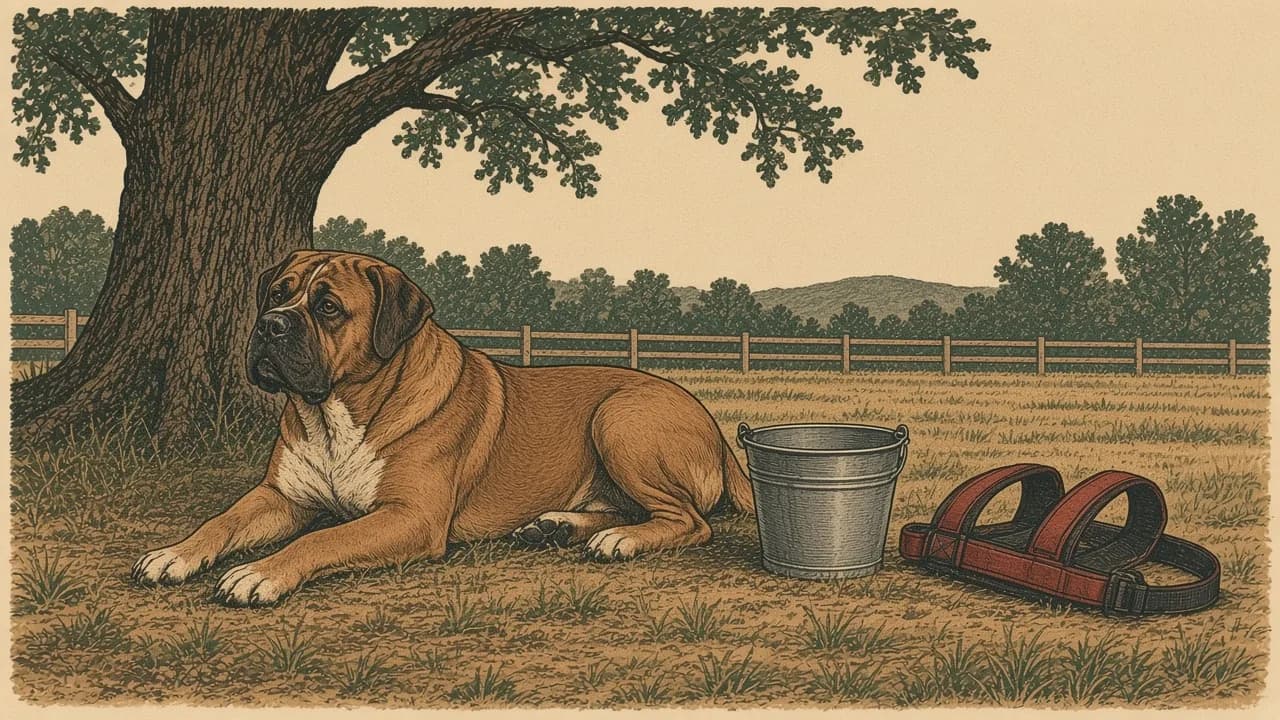
UKC guarantees a dog five minutes between pulls unless the handler waives it, and caps the pull area at 94.9°F. Shade, water and an unbuckled harness are the parts of a pull that no results sheet ever records.
Original AI-assisted illustration. A conceptual rest-period scene, not an event photograph or a depiction of a named competitor.Where the real risks sit
Rules only protect a dog where they are followed, and only cover what they mention. Four things strike us as the places to look, and the first is simply whether anyone is in charge at all.
Unsanctioned pulls.Every protection described above is a federation rule. At an informal pull run outside any sanctioning body, none of it is in force: no approved judge, no age floor, no load ceiling, no heat limit, no bar on pinch collars or bait, no misconduct procedure. The sport’s welfare case rests entirely on sanctioning, which is why the first question in our checklist is who sanctioned the event.
Surface and conditions. Surface is the biggest variable in weight pull, and it is a welfare variable before it is a scoring one. Both bodies require the dog to gain traction on the same surface the vehicle rides on, require a chute as level and firm as conditions permit, and permit grooming only between classes.[1, 4] The Royal Kennel Club’s general guidance for canine activities asks for a risk assessment of ground surfaces before an event starts, naming deep mud or sand, rutted, slippery and abrasive surfaces, and says competitions should not take place in conditions likely to compromise the dogs’ safety.[9]
Snow
A sled meets the most resistance. The totals are lower.
Wheels
The cart rolls, but grass, dirt and artificial surfaces differ.
Rails
Low rolling resistance allows much higher totals.
Conditioning and maturity.A one-year-old dog clears the age floor. It does not follow that a one-year-old dog of a slow-maturing breed should be climbing a load ladder, and we are not going to pretend there is a weight pull study on that, because there is not. What we can cite is the Royal Kennel Club’s position for canine activities generally: dogs must only undergo training that matches their physical capabilities and level of maturity, must be fit and in good health before training or competing, and must be allowed to recover fully after any treatment for injury before training restarts.[9] The RKC does not license weight pull, so that is a benchmark rather than a rule. It is still a reasonable bar to hold an event to.
Handler pressure, and the vet question.The rulebooks give a handler every legitimate exit: pass the round, take the rest, withdraw the dog. They also hand the decision to the person with the most invested in the result. The counterweight is the official, and here both North American rulebooks are thinner than the RKC benchmark. A UKC judge may excuse any dog whenever they reasonably believe the dog’s physical condition creates a risk of injury, and is responsible for checking the pull area is free of hazards and safe.[4] An IWPA Chief Judge may disqualify any dog they feel will be in danger of injury.[1, 2] Neither rulebook mentions a veterinarian at all, while the RKC says access to veterinary expertise should always be available by arrangement with a local practice, recommends dog first aid cover, and says a dog injured during competition must be retired and checked by a vet as soon as possible.[9] If we were asking a host one question, that would be it.
A spectator’s checklist
You do not need to know the rulebooks to judge an event. Seven questions get you most of the way, and every one of them is answerable from the rail.
01 Is the pull sanctioned, and by whom?
Every protection below comes from a rulebook. Outside a sanctioning body, none of them apply.
02 Is there an approved judge with authority over the chute?
IWPA Chief Judges must come from a board-approved list, and a UKC judge may excuse any dog whose physical condition creates a risk of injury.
03 Were dogs weighed and checked in?
Weigh-in sets the class and happens no more than 24 hours before the pull under both bodies. It is also where an unfit dog should be caught.
04 Are handlers using voice and hand signals only?
One handler, no touching once the dog is released, no whips or noisemakers, and no bait in the chute.
05 Is heat being managed, and is water available?
UKC caps the pull area at 94.9°F. IWPA's booklet sets no temperature limit at all, so this one is on the host.
06 Are dogs getting their rest between rounds?
UKC guarantees a five-minute rest between pulls unless the handler waives it. Watch whether anyone waives it repeatedly.
07 Is veterinary help arranged?
Neither weight pull rulebook requires it. Ask anyway, because the Royal Kennel Club's general guidance for canine activities says access to veterinary expertise should always be arranged.
Drawn from the two rulebooks and the Royal Kennel Club guidance cited throughout, all re-read on October 19, 2026.[1, 4, 9]
What this means for big breeds like the Boerboel
Large, heavily muscled breeds turn up at weight pulls, and the Boerboel has a documented history in the sport that we cover on our Boerboel weight pull guide. Size changes none of the rules above. The same age window, the same exclusions, the same ban on coercion and the same judge’s authority apply to a 180 lb dog and a 20 lb one.
What size changes is the arithmetic. Both bodies run body-weight classes and score on load per pound of dog, so a heavy dog is not competing against a light one, and UKC’s automatic withdrawal cap is itself expressed as a multiple of the dog’s own body weight rather than a flat poundage.[4] That is why a heavier dog’s bigger absolute number is not evidence of a bigger effort, and why a published ratio tells you more than a published total. If you want to see that play out on real paperwork, our guide to reading an IWPA results sheet walks the columns, and the cross-federation records ledger grades the record claims by how well each one is documented.
We will not go further than that here. We have no veterinary or academic source on giant-breed skeletal maturity in a pulling context, so we make no claim about one, and we make no claim that any breed is better or worse suited to the sport. The rule facts above are the rule facts, and the research gap is the research gap. Everything on this page was read from the sources listed below on October 19, 2026.
Weight pull safety and welfare: FAQ
Is dog weight pulling cruel?
Sanctioned weight pull is rule-bound in ways critics rarely credit: coercion is prohibited, the handler cannot touch the dog once it is released, whips and noisemakers and bait are banned from the chute, sick, lame, pregnant, nursing, very young and very old dogs are excluded, and the official can excuse any dog whose physical condition creates a risk of injury. Whether that framework is sufficient is a fair argument, and it is one no published injury-rate study can currently settle, because no such study of weight-pull dogs exists.
Is weight pulling bad for dogs?
The honest answer is that nobody has measured it properly. The only peer-reviewed study built around competitive weight-pulling dogs measured physiology rather than injuries, and found unremarkable blood chemistry and only a mild rise in lactate, from 1.4 to 2.1 mmol/l, which the authors read as little anaerobic metabolism compared with other canine sprinting athletes. That is reassuring about the metabolic cost of one day of pulling. It is not a clean bill of health on orthopaedic risk, which the study did not look at.
How old does a dog have to be to weight pull?
At least 1 year old in both of the large North American federations. IWPA also sets a ceiling of not more than 12 years of age at the beginning of the season, and UKC requires a dog to be under 12 on the day of the event. UKC separately treats a dog of 7 or older as a veteran for awards.
Do weight pull dogs get injured?
There is no published study of injury rates specific to weight pull, so we cannot give you a number. Surveys of other canine sports show injuries are common across dog athletics generally: owners of 4,701 agility dogs reported that 41.7 percent had an injury that kept the dog out for more than a week, and a Swedish survey of 1,582 sporting and utility dogs found 58.7 percent had been injured at some point in their lives, in or out of sport. Those figures come from different sports with different movement patterns and do not transfer to weight pull.
Can you use food or treats in weight pull?
Not in the chute. The current IWPA rule booklet prohibits having food or bait on your person in the chute area, on pain of disqualification, and allows a dog to be rewarded only once it has left the chute area and returned to its crate, vehicle or holding area. UKC likewise bars baiting and bars carrying bait in the on-deck area and the chute. IWPA's older Overview of a Pull page is stricter, saying no food other than water may be awarded during the class, not even between turns; where the two disagree, the rule booklet is the rule.
Are drugs and supplements banned in weight pull?
Yes. IWPA strictly prohibits performance-altering drugs, naming controlled substances, stimulants, oxygenators, depressants, anabolic steroids and their precursors, suppressants, CBD/THC and diuretics, and may declare drug testing on the entry form. UKC prohibits giving performance-altering drugs or supplements and bars dogs being issued them from competing.
Is a vet required at a dog weight pull?
Not by either rulebook we read. Neither the IWPA rule booklet nor the UKC Weight Pull Rulebook requires on-site veterinary cover or a veterinary check-in. By contrast, the Royal Kennel Club's voluntary guidelines for the canine activities it does license say access to veterinary expertise should always be arranged with a local practice, and that a dog injured in competition must be retired and checked by a vet as soon as possible. That gap is a reasonable thing to ask a host about.
Sources
Every rule, figure and finding above was read from these documents and re-checked on October 19, 2026. Where two sources from the same federation disagree, the article says so rather than choosing the more convenient one. Where no source exists, it says that too.
- [1] IWPA Rule Booklet, revised August 2026 (Section 3, officials; Section 4, contestants and eligibility; Section 5, the contest; Section 9, the season). International Weight Pull Association. http://www.iwpa.net/Rules.html
- [2] IWPA Rule Booklet 26-27, revised 07/26, the downloadable PDF edition. Its numbered items match the web rule booklet above. International Weight Pull Association. http://www.iwpa.net/files/Rule%20Booklet%2026-27%20(Revised%2007_26).pdf
- [3] Overview of a Pull, an explanatory page rather than a rule booklet. Cited here only where the article quotes it, including the point where it disagrees with the current rule booklet. International Weight Pull Association. http://www.iwpa.net/Pull-Overview.html
- [4] Official UKC Weight Pull Rulebook, effective September 1, 2016, revised October 30, 2019 (Chapter 1, eligibility; Chapter 2, exhibitors; Chapter 4, equipment; Chapter 5, procedures; Chapter 6, scoring; Definitions). United Kennel Club. https://www.ukcdogs.com/docs/rulebooks/weight-pull-rulebook.pdf
- [5] Weight Pull Forms and Rules. Its “Download the UKC Weight Pull Rulebook” link points to the 2016/2019 edition above, which is therefore the current published edition. United Kennel Club. https://www.ukcdogs.com/weight-pull-forms-rules
- [6] Frye CW, VanDeventer GM, Dinallo GK, Poplarski JA, Mann S, Pittman E, Zanghi BM, Wakshlag JJ. The effects of a post-exercise carbohydrate and protein supplement on repeat performance, serum chemistry, insulin and glucagon in competitive weight-pulling dogs. Journal of Nutritional Science 2017;6:e27. doi:10.1017/jns.2017.23. PMID 28630704. Journal of Nutritional Science (Cambridge University Press). https://pmc.ncbi.nlm.nih.gov/articles/PMC5468743/
- [7] Pechette Markley A, Shoben AB, Kieves NR. Internet-based survey of the frequency and types of orthopedic conditions and injuries experienced by dogs competing in agility. Journal of the American Veterinary Medical Association 2021;259(9):1001-1008. doi:10.2460/javma.259.9.1001. PMID 34647477. Journal of the American Veterinary Medical Association. https://avmajournals.avma.org/view/journals/javma/259/9/javma.259.9.1001.xml
- [8] Essner A, Kjellerstedt C, Hesbach AL, Igelström H. Injuries and associated factors in Swedish sporting and utility trial dogs: a cross-sectional study. Animals 2024;14(3):398. doi:10.3390/ani14030398. PMID 38338041. Animals (MDPI). https://pmc.ncbi.nlm.nih.gov/articles/PMC10854622/
- [9] Guidelines for owners and handlers with dogs taking part in canine activities. Voluntary welfare guidelines covering activities the Royal Kennel Club licenses. The RKC does not license weight pull, so these are cited as an external benchmark only. The Royal Kennel Club. https://www.royalkennelclub.com/about-us/about-the-rkc/what-we-do/the-royal-kennel-club-rules-regulations-and-codes/guidelines-for-owners-and-handlers-with-dogs-taking-part-in-canine-activities/